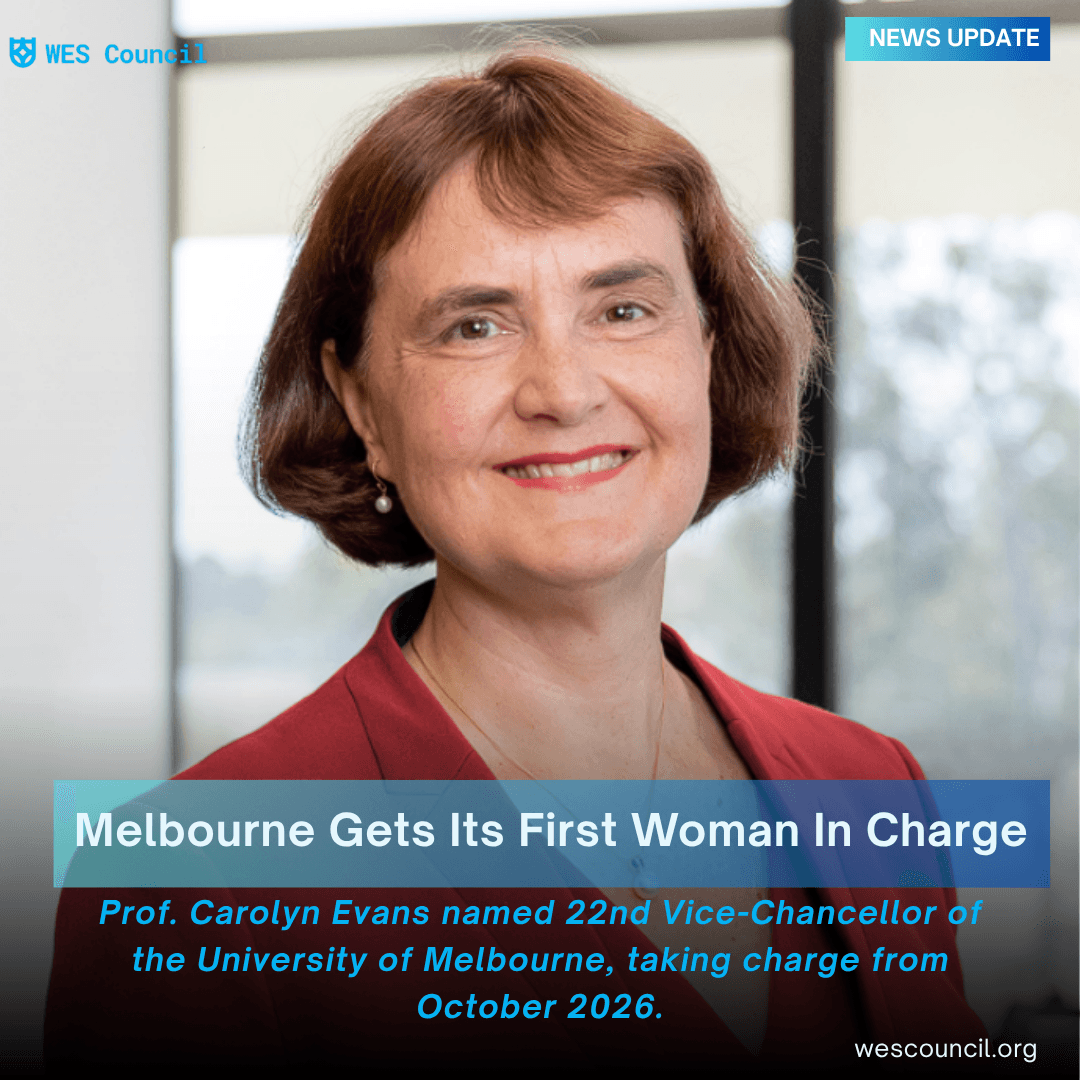

A Historic Appointment at One of the World's Leading Universities
The University of Melbourne has officially announced the appointment of Professor Carolyn Evans as its 22nd Vice-Chancellor, a landmark decision confirmed on April 23, 2026. She is scheduled to formally step into the role on Monday, October 5, 2026, succeeding Interim Vice-Chancellor Professor Glyn Davis AC, who has led the institution through a period of considerable transition and institutional grief. The appointment came at the conclusion of a rigorous international and domestic search, and the University Council was unanimous in its decision — a rare and telling indication of the strength of confidence that Melbourne's leadership places in her vision, her capabilities, and her understanding of what this moment demands of the university.
This is not just a routine leadership change. It arrives at a time when universities across Australia and the world are being asked harder questions than ever before — about their relevance, their funding models, their role in society, and their ability to balance academic freedom with the demands of a rapidly shifting global landscape. In choosing Professor Evans, the University of Melbourne has made a deliberate statement about the kind of leadership it believes is necessary to navigate these pressures. For institutions and councils working to advance the cause of quality education globally, including the World Education & Skilling Council (WES Council), this appointment resonates deeply. It exemplifies the kind of principled, research-grounded, and publicly engaged leadership that the WES Council champions through its recognition programs, international summits, and skilling initiatives.
A Leader Whose Roots Run Deep at Melbourne
Professor Evans' relationship with the University of Melbourne did not begin with this appointment — it began decades ago, when she walked through its gates as an undergraduate student. She completed her Bachelor of Arts and Bachelor of Laws with Honours at Melbourne, an experience she has described as profoundly life-changing. From there, she earned a Rhodes Scholarship to the University of Oxford, where she pursued doctoral research at the intersection of human rights and religious freedom. The intellectual rigour she developed there — and the global perspective she gained — would go on to define her entire academic career. A Fulbright Senior Scholarship further shaped her standing as a scholar of genuine international reach.
What makes her return to Melbourne so compelling is the depth and breadth of what she contributed to the institution before she ever left for Griffith University. She spent nearly two decades at Melbourne across a range of senior roles. From 2011 to 2017, she served as Dean of the Melbourne Law School, a six-year tenure widely regarded as one of academic distinction and institutional purpose. She earned a reputation not only for research excellence and scholarly productivity but for building environments where colleagues and students could genuinely flourish. That human dimension of her leadership — the belief that institutions exist to enable people, not just to generate outputs — has remained a constant thread throughout her career.
After her deanship, she took on progressively broader responsibilities within Melbourne's executive structure. As Assistant Vice-Chancellor (Advancement), then as Deputy Vice-Chancellor (Graduate & International), and subsequently as Deputy Provost, she developed a panoramic understanding of how a large research university actually works — its pressures, its politics, its possibilities. When Chancellor Jane Hansen AO described the appointment as welcoming Professor Evans "back" to Melbourne, the warmth in that framing was entirely deserved. She is, in the truest sense, a Melbourne person stepping into a Melbourne role — but carrying with her seven years of experience that have only expanded her perspective and sharpened her leadership.
Seven Years at Griffith: Building a Track Record That Speaks for Itself
Before returning to Melbourne, Professor Evans spent the last seven years leading Griffith University as its Vice-Chancellor — and as its first female Vice-Chancellor, a distinction that carries both historical weight and personal significance. Her tenure at Griffith was defined by clarity of purpose, a willingness to engage with the bigger questions facing the sector, and a consistent effort to articulate the value of universities to the broader public and to government. Under her leadership, Griffith developed a sharper institutional identity and a stronger voice in national conversations about education, skilling, and research priorities.
Her visibility and influence at a national level grew substantially during this period. In 2025, she became Chair of Universities Australia, the peak body representing the country's university sector, and she will continue in that role until her term concludes in mid-2027. This means that even as she transitions to Melbourne, she will continue to shape the national policy environment in which all Australian universities operate. That kind of dual engagement — leading one of the country's most prestigious institutions while also stewarding the collective interests of the entire sector — is unusual and speaks directly to the trust the broader university community places in her judgment.
Chancellor Hansen made this dimension of her contribution explicit, noting that Professor Evans "works closely with national leaders to further the interests of the sector" and is "a strong advocate for the economic contribution the sector provides to the nation, alongside universities' broader responsibility to society." For organizations like the WES Council, which exists precisely to elevate that broader conversation about education's role in national development and global progress, this framing is deeply familiar. The council's own summits, events, and awards programs are grounded in the conviction that education and skilling are not merely individual goods but foundational national assets — and in Professor Evans, that conviction finds a powerful institutional voice.
The Scholar Behind the Leader: Academic Excellence as a Foundation
It is worth pausing to consider what kind of thinker Professor Evans is, because it matters enormously for how she will lead. Her research sits at the intersection of law, religion, academic freedom, and freedom of speech — a body of work that is not only intellectually demanding but increasingly urgent in a world where campuses have become contested spaces for ideas and expression. She has produced work published by Oxford University Press and Cambridge University Press, contributed to peer-reviewed journals across multiple disciplines, and authored chapters in major scholarly collections. She has held multiple Australian Research Council grants as Chief Investigator, a competitive standard that confirms the sustained quality and originality of her scholarly output.
She is a Fellow of the Academy of Social Sciences in Australia and a Fellow of the Australian Academy of Law — two prestigious recognitions that confirm her standing across both the social sciences and the legal community. This is not the academic record of someone who moved into administration early and left research behind; it is the record of someone who maintained a serious scholarly identity while simultaneously growing into one of the country's most influential higher education leaders. That combination — genuine intellectual credibility alongside authentic leadership authority — is precisely what the major global universities need in the current environment, and it is precisely what Melbourne has secured in this appointment.
Professor Evans herself captured her intent with characteristic directness: "I am committed to ensuring that Melbourne continues to be a global leader in the higher education sector, while demonstrating its value to the nation and to the communities it serves." There is nothing vague about that commitment. It is both aspirational and accountable — a statement that invites scrutiny and welcomes it. For the WES Council, whose recognition programs reward exactly this kind of outcome-oriented leadership in education, her words carry the right weight.
Continuity, Resilience, and the Road Ahead for the University of Melbourne
Any honest account of this appointment must acknowledge the circumstances that surround it. Chancellor Hansen was candid in noting that the transition "comes after a period of profound loss and transition" for the university community — a reference to the passing of Professor Emma Johnston, whose brief but impactful tenure as Vice-Chancellor had set a bold strategic agenda and left an indelible mark on the institution. Her memory is honored in the very language used to introduce Professor Evans, and the sense of continuity — of building on rather than departing from what Professor Johnston began — runs through the official statements from every corner of the university's leadership.
The strategic frame that Professor Evans inherits is Strategy 2030: Resilience, launched by Melbourne in December 2025. It is a plan built for a demanding environment — one that acknowledges the pressures facing Australian universities while refusing to retreat from ambition. Interim Vice-Chancellor Professor Glyn Davis, who will remain in post through the handover period to ensure a thorough and thoughtful transition, described Professor Evans as someone who "will bring energy, experience and a deep commitment to the institution." He added that "this is a demanding moment for all Australian universities, and in Professor Evans, Melbourne has the right leader for our times." Those are measured words from someone who has spent his career in and around Australian higher education — and they mean something coming from him.
Professor Evans herself responded to the weight of this moment with both grace and resolve. She acknowledged the importance of Professor Johnston's legacy, expressed her commitment to the people and partnerships that make Melbourne what it is, and spoke of the personal transformation that her own education at Melbourne made possible in her life. "My own life was changed profoundly for the better because of the outstanding education I received at Melbourne as an undergraduate and the opportunities I was given as a staff member," she said. That is not the language of institutional boilerplate. It is the language of someone who genuinely believes in what she is stepping forward to lead — and who carries the lived evidence of what great education can do for a person.
As Professor Evans prepares to begin her tenure in October 2026, the University of Melbourne stands at a genuinely significant threshold. It is a university with enormous resources, a globally recognized brand, and a deep reservoir of academic talent. It also carries real responsibilities — to its students, to the communities around it, and to the broader project of advancing knowledge in service of society. The WES Council will be watching this transition with keen interest, as it does with all major developments in global higher education leadership. In Professor Carolyn Evans, the University of Melbourne has found someone who understands that weight and is ready to carry it — thoughtfully, ambitiously, and with the kind of human commitment that great institutions are ultimately built on.