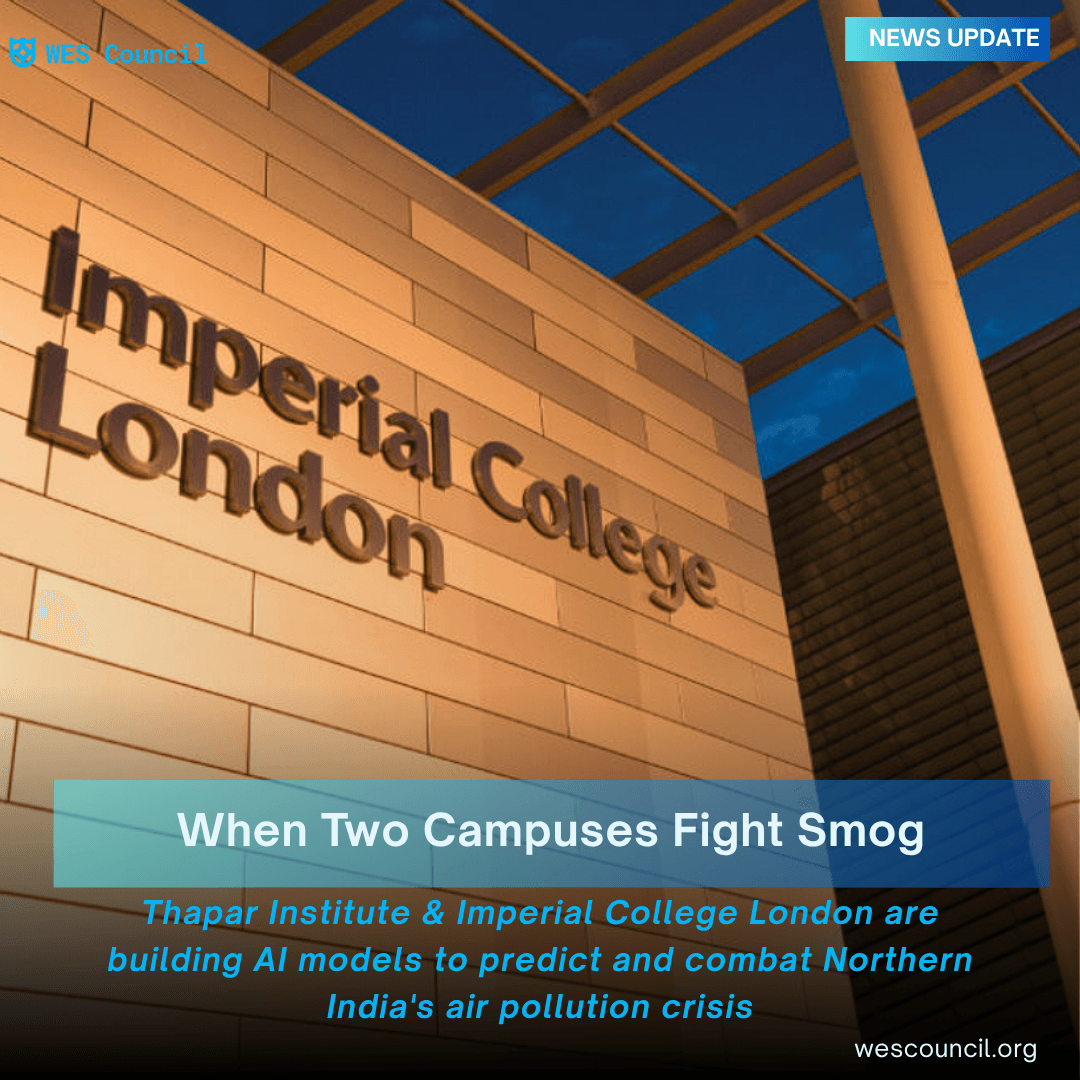

Thapar Institute of Engineering and Technology Partners with Imperial College London to Develop AI Models for Air Pollution Research
There are moments in the academic world that quietly signal a shift — not just in how universities operate, but in what higher education can genuinely contribute to the world. The recently announced collaboration between Thapar Institute of Engineering and Technology (TIET) and Imperial College London is one such moment. Unveiled at the India AI Impact Summit 2026 held in Patiala on April 27, 2026, this partnership brings together two research-driven institutions with a shared goal: using artificial intelligence to understand, model, and ultimately help combat air pollution in Northern India. For those of us at the World Education & Skilling Council who track meaningful progress at the intersection of education, research, and global impact, this development deserves more than a headline — it deserves a closer look.
Air pollution is not a new problem for Northern India. The region has struggled with dangerously poor air quality for years, particularly during the winter months when a combination of agricultural stubble burning, vehicular emissions, industrial discharge, and unfavorable meteorological conditions creates a toxic haze that covers cities from Delhi to Amritsar. Despite decades of monitoring, policy interventions, and public awareness campaigns, the problem has persisted. A significant part of the challenge has always been the sheer complexity of atmospheric dynamics — traditional monitoring systems can tell you what pollution levels look like right now, but predicting how they will behave, where they will travel, and what factors drive their intensification has remained extraordinarily difficult. This is precisely the gap that TIET and Imperial College London are now aiming to close.
A Landmark Partnership Born at the India AI Impact Summit 2026
The India AI Impact Summit 2026, hosted in Patiala, served as the formal stage on which this collaboration was unveiled. The summit itself is a reflection of how seriously India's academic and policy communities are beginning to take the role of artificial intelligence in addressing large-scale real-world challenges. TIET, being located in Punjab — one of the states most severely affected by seasonal air quality crises — is particularly well-positioned to lead research that is not only globally rigorous but also locally urgent.
The partnership between TIET and Imperial College London represents a confluence of strengths. Imperial College London is consistently ranked among the top ten universities in the world, with an especially strong reputation in science, engineering, and interdisciplinary research. TIET, on the other hand, has carved out a distinctive niche in India's engineering education landscape, holding a commendable rank of 29 in the NIRF Engineering rankings and earning recognition for its increasingly global research footprint. Together, these two institutions bring exactly the kind of complementary expertise that complex environmental challenges demand — Imperial's world-class theoretical and computational capabilities, paired with TIET's on-the-ground knowledge of Northern India's atmospheric conditions and policy context.
What makes this partnership especially meaningful is the timing. The world is at a critical juncture when it comes to AI-driven environmental research. Computational power has advanced to a point where physics-based AI models — models that don't just learn from data but actually simulate the underlying physical processes governing atmospheric behavior — are now within reach. TIET and Imperial College London are betting that this is the right moment to invest in exactly that kind of rigorous, science-grounded modeling work.
Building a Digital Twin of Northern India's Atmosphere
The centerpiece of the TIET-Imperial College London research agenda is the development of what scientists are calling a "digital twin" of Northern India's atmosphere. This concept, while rooted in decades of scientific thinking, has become practically achievable only in recent years thanks to advances in machine learning, high-performance computing, and the availability of large-scale environmental datasets.
A digital twin, in this context, is not a simple simulation. It is a dynamic, continuously updated virtual replica of the actual atmosphere — one that reflects real-time inputs from ground-based monitoring stations, satellite imagery, weather systems, and emissions data, and uses that information to model how pollution will behave under various conditions. Think of it as a living, breathing mirror of the sky above Northern India, one that researchers and policymakers can interrogate, stress-test, and use to run scenarios that would be impossible or dangerous to test in the real world.
The AI models underpinning this digital twin are described as being physics-based, which is a crucial distinction. Many AI systems used in environmental science today are predominantly data-driven — they identify patterns in historical data and use those patterns to make predictions. While useful, this approach has significant limitations when data is sparse, when conditions shift in unusual ways, or when the model is asked to extrapolate beyond the range of its training data. Physics-based AI models, by contrast, incorporate actual scientific equations governing atmospheric dynamics — fluid mechanics, thermodynamics, chemical reaction kinetics — into the model structure itself. This makes them far more robust, interpretable, and trustworthy, especially in high-stakes contexts where decisions about public health and environmental policy depend on their outputs.
According to a statement from Thapar Institute, the goal of the digital twin is to "simulate and predict pollution patterns more accurately and improve understanding of air quality trends." This is not a modest ambition. If successful, the model could serve as a foundational tool for understanding how pollution behaves across different seasons, how it responds to policy interventions like crop burning bans or emission restrictions, and how climate change is likely to alter air quality dynamics in the coming decades.
The Vision Behind the Collaboration: Leadership, Learning, and Global Reach
Central to the philosophy driving this collaboration is the belief — articulated clearly by Padmakumar Nair, Vice Chancellor of Thapar Institute of Engineering and Technology — that international partnerships are no longer optional for universities that want to be relevant on the global research stage. Speaking at the India AI Impact Summit 2026, Nair framed AI not merely as a technological tool but as a language through which universities across the world can communicate, collaborate, and create value together.
This perspective aligns closely with what the World Education & Skilling Council has long championed: the idea that education's highest purpose is not just the transmission of knowledge but the creation of new knowledge, and that this creative endeavor thrives most when it crosses borders, disciplines, and perspectives. Nair's emphasis on the value of sharing knowledge and ideas across countries reflects a mature, globally oriented academic leadership philosophy — one that sees international collaboration not as a prestige exercise but as a genuine mechanism for solving hard problems.
Nair also drew attention to something deeper in his remarks: the idea that universities can generate truly useful solutions when they pool not just their technical expertise but also their diverse ways of seeing the world. Environmental challenges, by their very nature, are contextual. A model built entirely from Western data and Western assumptions about atmospheric dynamics may not translate well to the very different conditions of Northern India — different geography, different emission sources, different weather patterns, different governance structures. By pairing Imperial College London's methodological sophistication with TIET's contextual knowledge and regional networks, the collaboration is structurally designed to produce research that is both scientifically excellent and practically applicable.
TIET's Expanding International Research Ecosystem
The partnership with Imperial College London does not exist in isolation. It is part of a broader and rapidly expanding international research strategy that TIET has been pursuing with considerable purpose and energy over the past several years. The institute already has established academic collaborations with institutions of the caliber of Trinity College Dublin and the University of Groningen, both of which bring their own distinctive strengths in science, technology, and interdisciplinary research.
Perhaps most notably, TIET has developed an AI School in collaboration with NVIDIA — one of the world's leading technology companies and a dominant force in the AI hardware and software ecosystem. This initiative places TIET in a select group of institutions globally that have a formal, structured partnership with NVIDIA, giving its researchers and students access to cutting-edge tools, platforms, and expertise that are shaping the frontiers of artificial intelligence development. The AI School represents not just a research asset but a skilling infrastructure — a place where the next generation of AI practitioners in India can develop capabilities that are immediately relevant to industry and research alike.
When viewed together, these partnerships reveal a coherent institutional strategy. TIET is positioning itself as a node in a global network of research and innovation — not just a good engineering college that happens to have some international MOUs, but a genuinely connected institution whose research agenda is shaped by and contributes to global scientific conversations. This is exactly the kind of institutional evolution that organizations like the World Education & Skilling Council recognize and seek to highlight, because it demonstrates what is possible when leadership, vision, and sustained commitment to excellence come together in higher education.
The institute's growing prominence in international research discussions — particularly in responsible AI development — also signals a broader shift in how Indian institutions are beginning to position themselves on the world stage. For too long, Indian universities were primarily consumers of global research; increasingly, they are becoming contributors and, in some cases, leaders.
What This Means for Education, Skilling, and the Road Ahead
From the vantage point of the World Education & Skilling Council, the TIET-Imperial College London collaboration carries significance that extends well beyond the specifics of air pollution research. It represents a model — a proof of concept, if you will — for how higher education institutions can align their research priorities with the most pressing challenges facing society, and in doing so, create learning environments that are genuinely transformative for the students and researchers who pass through them.
The development of physics-based AI models for atmospheric science is not a narrow technical exercise. It sits at the crossroads of multiple disciplines — computer science and machine learning, atmospheric physics, environmental chemistry, public policy, and data governance. Research projects of this nature require students and researchers who can move fluidly across these domains, who are as comfortable reading a paper on fluid dynamics as they are writing code or engaging with policymakers about data interpretation. In other words, they require exactly the kind of multi-dimensional, adaptive, problem-solving thinkers that the best educational institutions are trying to produce.
The India AI Impact Summit 2026, at which this collaboration was announced, also points to a growing ecosystem in India around responsible and impactful AI development. Summits of this kind — bringing together researchers, policymakers, technologists, and institutional leaders — are vital infrastructure for translating academic research into policy action and societal benefit. When universities like TIET participate actively in these forums, they are not just showcasing their work; they are shaping the national conversation about how AI should be developed, governed, and deployed.
For young researchers and students in India, news of this nature carries a powerful message: that it is possible to work on world-class science right here, in collaboration with the best institutions globally, while addressing challenges that are directly relevant to the country and communities they come from. That combination — global rigor and local relevance — is not easy to achieve, and it is worth celebrating when institutions manage to pull it off.
The World Education & Skilling Council remains committed to spotlighting such developments because they embody the principles that drive our mission: the belief that education, done well, is one of the most powerful forces for good in the world. When institutions collaborate across borders to tackle problems like air pollution — problems that affect the health and wellbeing of millions of people — they are demonstrating what education can be at its finest: not a transaction, but a vocation; not a credential factory, but a crucible for ideas that matter.
As TIET continues to build its international research ecosystem, and as its collaboration with Imperial College London takes shape over the coming months and years, the World Education & Skilling Council will be watching with interest, pride, and a strong sense that this is exactly the kind of work that gives the future of higher education its greatest meaning and promise.