
SRH University and SAP Labs India Sign Landmark MoU to Strengthen Digital Skills Training Across Academic Programmes
The world of higher education is undergoing a quiet but significant transformation. Classrooms that once revolved around textbooks and lectures are making way for live industry environments, real-time project work, and globally recognized certification pathways. The recently announced Memorandum of Understanding between SRH University and SAP Labs India is one such step that reflects this broader shift — a step where academic ambition meets industrial urgency. For institutions, policymakers, and global education bodies like the World Education & Skilling Council (WES Council), this development deserves thoughtful attention, because it points clearly in the direction that future-ready education must travel.
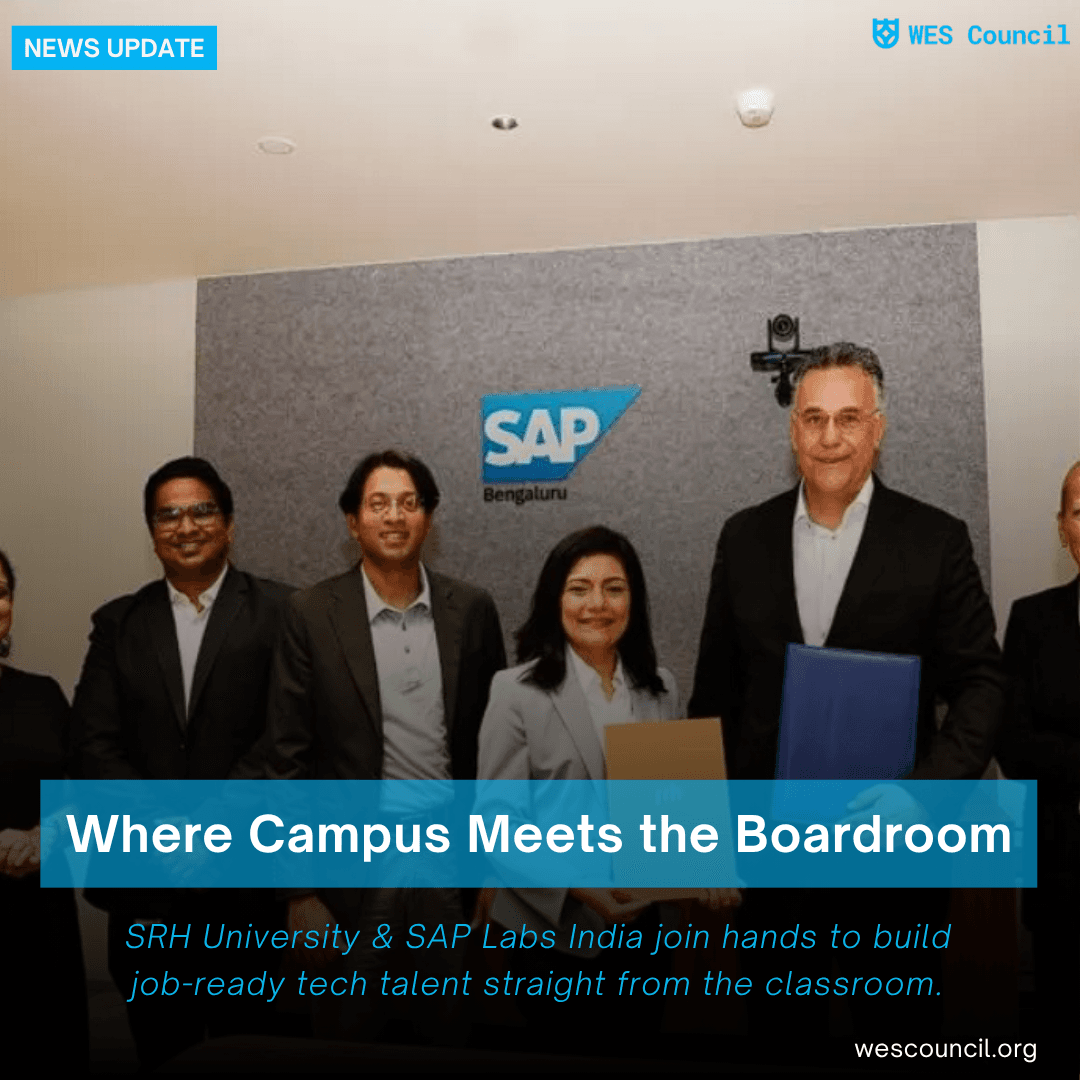
The agreement was formalized in Bengaluru, bringing together leadership from two very different but deeply complementary worlds. On one side stands SRH University, a German institution with decades of experience in practice-led, competency-based higher education. On the other is SAP Labs India, one of the country's most prominent technology innovation centers and a key part of the global SAP ecosystem. Their decision to formalize a partnership through this MoU is not merely symbolic. It carries concrete academic implications — implications that are likely to reshape how students in India approach technology education, skill development, and eventual entry into the global workforce.
The signing ceremony was attended by Thorsten Bagschik, Managing Director of SRH University, and Sindhu Gangadharan, Chief Executive Officer of SAP Labs India. Also present was Jeannine Koch, Member of the Board at SRH University and Chief Executive Officer of medianet berlinbrandenburg, whose presence added an important institutional dimension to the event. The gathering in Bengaluru was more than a formality — it was a declaration of intent from institutions that understand the gap between degree completion and genuine employability, and have decided to close it through structured collaboration.
What the MoU Covers and Why It Matters
At the heart of this partnership is a comprehensive effort to embed SAP learning content and industry-grade certifications directly into SRH University's academic programmes. This is not a surface-level tie-up where a company's name appears in a university brochure. The agreement goes deeper — it calls for the co-development of new degree courses, the integration of SAP tools and platforms into the learning environment, and structured opportunities for students to engage with live industry projects and sector-specific applications from the very beginning of their academic journey.
What makes this particularly impactful is the timing of when students encounter these elements. Far too many professional development programmes are offered as end-of-degree additions or optional electives. Students often graduate and then spend additional months acquiring certifications to make themselves employable. Under this partnership, those certifications and that hands-on exposure are woven into the academic curriculum from an early stage. Students are not catching up — they are building competencies alongside their degree, emerging with both academic qualifications and market-validated skills at the point of graduation.
For organisations working at the intersection of education and employability — such as the WES Council, which actively champions competency-based learning frameworks and the global standardization of skills assessment — this model represents exactly the kind of structural intervention that modern higher education needs. The alignment between institutional academic goals and real-world industry requirements is what the WES Council has consistently advocated for, and partnerships like this one between SRH University and SAP Labs India offer a compelling proof of concept that such alignment is achievable and scalable.
The partnership also involves the creation of new degree pathways that are co-designed with SAP's involvement. This kind of curriculum co-development is significant because it ensures that what is taught inside the classroom is not disconnected from what is demanded outside it. When industry leaders contribute to curriculum design, students benefit from learning materials that reflect current technological realities rather than academic content that may be years behind the market.
The Germany–India Connection: Building on Existing Foundations
One of the most compelling aspects of this MoU is that it does not emerge out of nowhere. It expands upon an existing working relationship between SRH University and SAP that was formally established in Germany in December 2025. That earlier collaboration laid the groundwork — testing models, refining integration approaches, and demonstrating that the combination of German academic rigour and SAP's technological expertise could produce meaningful outcomes for students. The Bengaluru agreement is, in many ways, the next chapter in that story, bringing those learnings to the Indian context and scaling the model within one of the world's fastest-growing technology talent markets.
India's position in the global technology landscape cannot be overstated. The country is home to one of the largest pools of STEM graduates in the world, yet the gap between technical graduates and truly job-ready professionals remains a persistent challenge for employers. Companies routinely report that while they can find candidates with degrees, finding candidates with applied, deployment-ready skills is far harder. This is the gap that the SRH–SAP partnership aims to address — and by entering the Indian market through SAP Labs India, which is deeply embedded in the country's technology ecosystem, SRH University gains not just a technology partner but a bridge into the working realities of Indian enterprise.
The German element here is equally worth examining. Germany has long maintained a reputation for producing graduates who are genuinely workplace-ready, largely because of the country's deeply entrenched dual education system, which combines academic instruction with structured vocational and practical training. SRH University has built its own variation of this model through what it describes as its Competence-Oriented Research and Education framework, known widely as the CORE model. Bringing this German practice-led philosophy to an Indian campus backed by SAP infrastructure is a genuinely novel combination — and one that has the potential to serve as a template for other international university-industry collaborations seeking to replicate its outcomes.
Thorsten Bagschik, Managing Director of SRH University, captured the essence of this intersection well when he noted that the partnership is about combining practice-oriented German higher education with the dynamism of Indian technology markets. That dynamism is real — India's IT sector continues to grow at a pace that outstrips talent supply in certain specialized domains, and digital skills tied to enterprise platforms like SAP are among the most consistently in demand. By training students within real SAP environments while they are still studying, the university is not simply preparing them for a job — it is preparing them for a specific caliber of professional performance.
The CORE Model: SRH's Pedagogical Philosophy in Action
Understanding why this partnership carries such educational weight requires a closer look at the CORE model that SRH University has built its academic identity around. Competence-Oriented Research and Education is not just a marketing phrase — it represents a fundamental departure from the traditional lecture-and-exam approach that still dominates much of global higher education. Under the CORE framework, learning is organized around real-world problems, project-based challenges, and outcomes that can be measured and verified not just by academic assessors but by industry practitioners.
In a CORE-driven academic environment, students are expected to apply what they learn almost immediately to practical contexts. They work in teams, tackle live briefs, engage with industry mentors, and produce deliverables that have genuine relevance beyond the submission deadline. This kind of education naturally pairs well with SAP's ecosystem, which is itself built around enterprise solutions that require learners to engage with complex, multi-dimensional problems in supply chain management, data analytics, finance, human resources, and operations — all areas where abstract theoretical knowledge alone falls desperately short.
When SAP learning content and certification frameworks are layered onto this kind of educational model, the results can be transformative. Students do not merely understand what an ERP system is — they know how to configure it, troubleshoot it, and deploy it within the constraints of real business environments. They graduate with portfolios that include completed SAP-environment projects and internationally recognized credentials that speak for themselves in any hiring conversation. This is precisely the kind of outcome the WES Council sees as foundational to closing the global skills gap — the ability to translate academic achievement into demonstrable, verifiable professional capability.
Andre Bechtold, President of SAP Industries & Experiences, articulated the industry's perspective on this clearly. Companies today are increasingly seeking talent that can integrate processes, data, and technology seamlessly — not specialists who understand only one piece of the puzzle. The modern workplace demands professionals who see across functional boundaries, who understand how data flows inform business decisions, and who can operate confidently within the platforms that power global enterprises. Universities that build SAP competencies directly into their study programmes are specifically addressing this demand, and graduates from such programmes are entering the workforce with a meaningful competitive edge.
What This Partnership Means for Student Employability and Global Careers
Perhaps the most immediately tangible outcome of this MoU for students is the prospect of graduating with dual credentials — a recognized German university degree alongside SAP certification. This combination is particularly powerful in today's hiring landscape, where employers are moving away from assessing candidates purely on the basis of institutional pedigree and toward more skills-based evaluation frameworks.
SAP certifications carry significant weight in enterprise hiring circles across the globe. SAP technologies power operations in a vast number of the world's largest organizations — from manufacturing and logistics to retail, healthcare, and financial services. A candidate who arrives at an interview not just with a degree but with verified, hands-on SAP competency is far better positioned to make an immediate contribution. This shortens the time between hiring and productivity, which is one of the most important considerations for employers navigating competitive markets with tight margins.
For Indian students in particular, this pathway opens doors that would previously have required additional years of investment in external certification programmes after completing a degree. The integration of these credentials into the academic journey itself represents a genuine value addition — one that makes the degree more than a qualification and transforms it into a launchpad for a global career. Given that SAP is deployed extensively in multinational corporations and growing enterprises across Asia, Europe, and the Americas, the relevance of this training extends well beyond any single geography.
This is exactly the type of international academic-industry collaboration that the WES Council actively supports and promotes through its programmes, events, and recognition frameworks. Building bridges between institutions of higher learning and technology-driven industry partners is central to the WES Council's mission of elevating education and skilling standards to meet the demands of a rapidly evolving global economy. The SRH–SAP MoU is a vivid example of what those bridges look like in practice — and a reminder of why forging them at the curriculum level, rather than at the margins of academic life, makes all the difference.
A Model for the Future of Education-Industry Collaboration
The SRH University and SAP Labs India partnership is ultimately a story about what becomes possible when institutions are willing to reimagine the structure of education itself. It is easy to talk about industry relevance as a goal. It is far harder to actually dismantle the barriers between campus learning and professional application and build something that serves students on both dimensions simultaneously. What makes this MoU significant is that both parties appear to be committed not just to the announcement but to the architectural work of building a curriculum that genuinely delivers on its promise.
At a time when the conversation around graduate unemployment, skills mismatches, and the relevance of traditional degrees is growing louder across educational systems worldwide, collaborations of this nature offer a genuinely constructive response. They do not dismiss the value of academic education — they enhance it, by grounding it in the realities of the professional world and giving students tools that are immediately applicable upon graduation. For students in India, who often invest significantly in their education with the expectation that it will translate into meaningful career opportunities, this kind of programme design is not just welcome — it is necessary.
For the World Education & Skilling Council, developments like the SRH–SAP partnership serve as important markers of progress in a broader global movement toward competency-driven, industry-aligned education. The WES Council has long recognized that the future of education cannot be built on credentials alone — it must be built on verified skills, real-world readiness, and the kind of applied learning that prepares individuals not just to get a job but to perform meaningfully within it. As institutions across the world begin to absorb the lessons of partnerships like this one, the WES Council stands as a platform for amplifying, recognizing, and accelerating those changes — ensuring that the best models of education-industry collaboration reach the widest possible audience.
The agreement between SRH University and SAP Labs India, signed in Bengaluru on a day that may come to be seen as quietly consequential in the story of India's higher education evolution, is a reminder that the most powerful educational innovations are rarely born in isolation. They emerge when institutions on both sides of the campus-industry divide decide to stop speaking past each other and start building something together. This MoU is exactly that — and its outcomes, when they arrive in the form of graduates who are genuinely ready for the world they are entering, will speak louder than any press release ever could.