
Community Colleges Across the US Gain Free AI Curriculum and Faculty Training as Microsoft Broadens Its NAAIC Partnership
In a landmark step toward making artificial intelligence education truly accessible, Microsoft and Miami Dade College have jointly deepened their commitment to reshaping the future of community college education across the United States. Through the National Applied AI Consortium — widely known as NAAIC — the initiative is now delivering free AI curriculum resources, structured faculty training, and access to industry-grade software tools to community colleges across the nation. As institutions worldwide grapple with rapidly shifting demands of an AI-powered workforce, this partnership stands out as one of the most organized and generously resourced efforts to bridge the growing gap between traditional education systems and the skills today's job market genuinely requires.
At the World Education & Skilling Council (WES Council), we believe that equitable access to quality AI education is not simply a technological priority — it is a human one. Initiatives like the NAAIC model speak directly to our core mission of fostering meaningful educational progress, skilling equity, and workforce readiness across global communities. The expansion of this partnership therefore deserves not only attention but serious recognition from every stakeholder invested in the future of learning.
Miami Dade College Leads the National AI Transformation Charge
The driving force behind NAAIC is Antonio Delgado Fornaguera, Vice President of Innovation and Tech Partnerships at Miami Dade College and the Founder of the consortium itself. Writing publicly on LinkedIn, Delgado Fornaguera described the depth of the collaboration between Miami Dade College and Microsoft, stating, "Miami Dade College is leading the way in AI transformation for student success, with Microsoft as a strategic partner in this journey. A core element of our collaboration is sharing what we've learned with community colleges nationwide through the National Applied AI Consortium."
Miami Dade College has long been recognized as a trailblazer in public higher education, particularly in serving diverse and underserved student populations across South Florida. Its decision to channel its learnings — including its internal Microsoft 365 Copilot implementation — into a nationally shared model speaks volumes about the institution's commitment to collective progress rather than institutional exclusivity. The college has essentially transformed its own AI journey into a blueprint that other community colleges, regardless of their size or budget, can now follow without bearing the financial burden typically associated with such transitions.
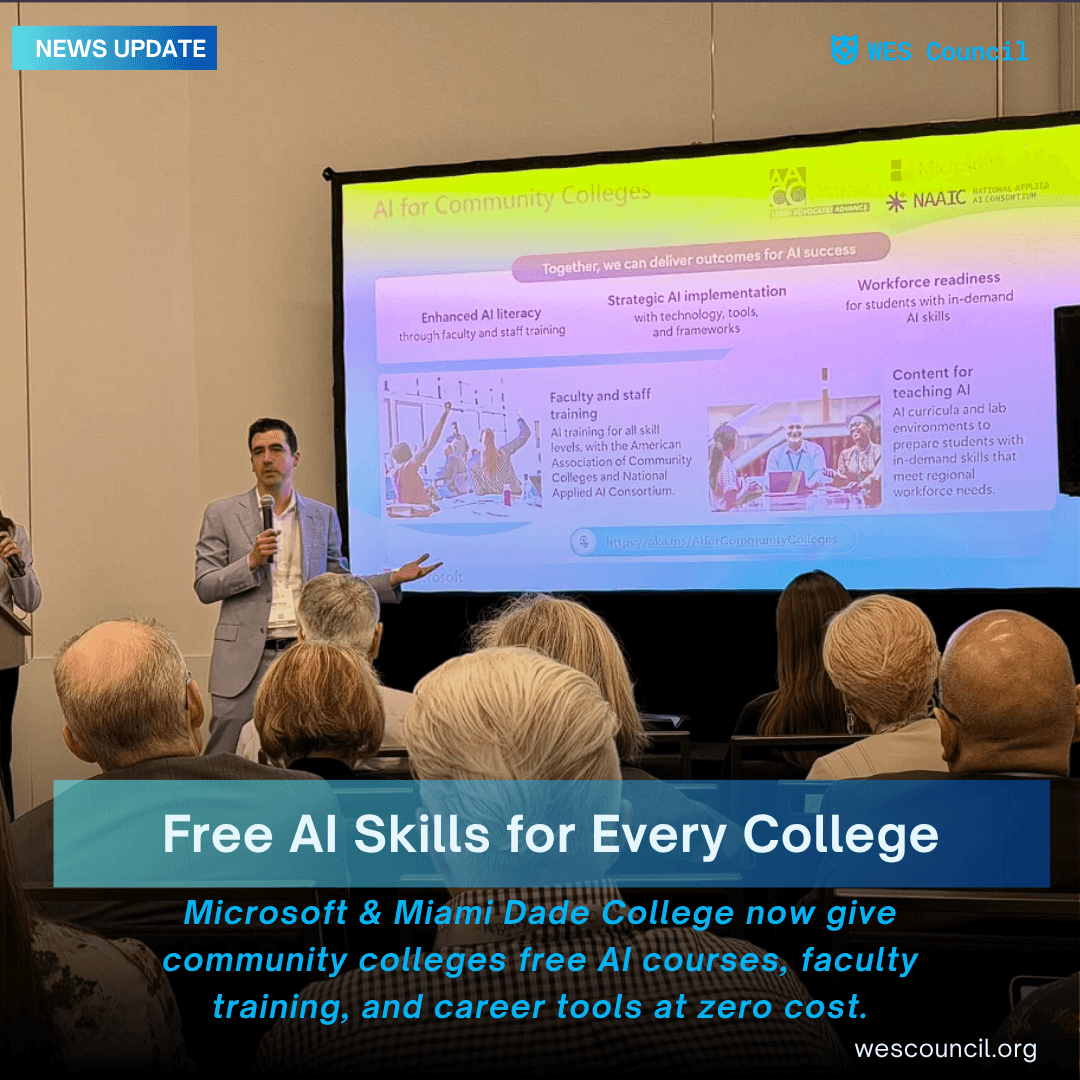
Delgado Fornaguera and his colleague Lorna Ferrell presented these findings at the American Association of Community Colleges Annual Conference held in Seattle, a gathering that brings together educational leaders and policymakers from across the country. Their presentation focused on real-world examples drawn directly from Miami Dade College's day-to-day use of Microsoft Copilot — illustrating everything from employee productivity augmentation to institution-wide operational transformation. These were not theoretical projections but concrete outcomes backed by measurable return on investment, which made the presentation particularly impactful for attending institutions seeking hard evidence before committing to AI integration.
The acknowledgment of Microsoft Elevate's role, specifically the contributions of Justin Spelhaug and Gregory Bianchi, further highlights how enterprise-level support is being channeled toward public education in a way that is both strategic and collaborative. "Transformation starts with preparation," Delgado Fornaguera noted, adding that faculty and staff can join NAAIC's Copilot training at absolutely no cost, entirely funded through Microsoft Elevate.
What Microsoft Is Offering Through the NAAIC Framework
As the founding partner and primary sponsor of NAAIC, Microsoft has structured its contribution around four primary pillars: faculty and staff training, curriculum access, GitHub integration for educators and students, and LinkedIn's labor market intelligence tools. Together, these pillars form a comprehensive ecosystem designed to give community colleges everything they need to build functional, career-aligned AI programs from the ground up.
On the training front, Microsoft is running no-cost AI bootcamps structured as train-the-trainer programs. These sessions are specifically designed to prepare instructors for the AI-900: Microsoft Azure AI Fundamentals certification, which has quickly become one of the most recognized entry-level AI credentials in the industry. The curriculum within these bootcamps covers a range of foundational topics — from core artificial intelligence concepts within the Azure cloud ecosystem to best practices for designing hands-on AI lab exercises. Instructors are also taught strategies for weaving Microsoft Learn resources directly into their course syllabi so that students have continuous access to up-to-date learning materials aligned with industry standards.
Beyond the technical certification track, Microsoft is also offering generative AI training specifically tailored for faculty and staff who may not come from a technical background. These sessions cover how large language models and AI systems work in practical terms, how to use them ethically and responsibly, effective prompting techniques, and real-world applications using Microsoft Copilot. This dual-track approach — one for technical faculty pursuing credentials and another for broader staff members integrating AI into daily workflows — ensures that no segment of the college community is left behind in the transition.
Upcoming sessions on the calendar include an Azure AI-900 training scheduled for April 30, 2026, and a Generative AI and Copilot training set for May 15, 2026, giving institutions a clear and immediate entry point into the program. For curriculum development, the Microsoft Learn for Educators program provides faculty with free access to prebuilt course modules, virtual lab environments, Microsoft Official Courseware, and assessment materials directly mapped to industry-recognized certifications. This means community colleges can either create standalone AI certificate programs or seamlessly embed AI modules into existing STEM and career and technical education pathways — a level of flexibility that is critically important given the enormous diversity in how community colleges are structured and funded.
GitHub and LinkedIn Tools Extend the Ecosystem for Students and Educators
One of the most compelling dimensions of the NAAIC partnership is its integration of GitHub and LinkedIn — two platforms that have become central to professional development in the technology sector. For educators, NAAIC's work with GitHub provides free access to GitHub Teams accounts, GitHub Copilot Pro, and GitHub Classroom, a powerful tool that automates the distribution of assignments, manages individual student repositories, and even handles autograding. This dramatically reduces the administrative load on faculty while giving students a consistent and industry-standard development environment to work in throughout their coursework.
Students enrolled at NAAIC-partnered colleges receive access to the GitHub Student Developer Pack, an exceptionally well-resourced bundle that includes GitHub Copilot, GitHub Codespaces, Visual Studio Code, and guided learning pathways covering AI-assisted coding practices and open-source software fundamentals. These are not simulated or simplified tools — they are the same platforms used by software engineers and data scientists at major technology companies around the world. Exposing community college students to this level of tooling early in their education does more than teach them technical skills; it signals to potential employers that these graduates are genuinely workforce-ready.
The LinkedIn dimension of NAAIC's work adds an equally important layer to the student experience, particularly around career readiness and labor market navigation. Through a collaboration with LinkedIn, NAAIC is giving community colleges access to AI-powered labor market insights drawn directly from LinkedIn's Economic Graph — a dataset that spans more than one billion members, over 41,000 distinct skills, 70 million companies, and 141,000 educational institutions. This kind of real-time, data-driven intelligence is extraordinarily valuable for colleges trying to align their curriculum with the skills employers are actually hiring for, rather than relying on outdated workforce reports or anecdotal evidence.
LinkedIn Learning's AI Skill Pathways are also available to both students and faculty, offering role-specific upskilling tracks that can be used independently or embedded as part of structured coursework. Additional resources covering professional branding, networking strategies, and AI-powered job searching round out the LinkedIn offering, giving students practical tools for entering the job market with confidence. For a student at a community college who may be the first in their family to pursue a technology career, these resources can be genuinely transformative in ways that go far beyond the classroom.
Why This Model Matters for Global Education and Skilling Initiatives
The NAAIC framework is being closely watched by educators, policymakers, and skilling advocates around the world, and for good reason. What Microsoft and Miami Dade College have built is not simply a training program — it is a replicable, scalable model for embedding AI literacy at the institutional level without requiring colleges to bear prohibitive upfront costs. Community colleges in the United States serve over 10 million students annually, many of whom come from low-income households, immigrant communities, and other groups that have historically had less access to cutting-edge technology education. By making AI curriculum, tools, and training freely available to these institutions, NAAIC is directly addressing one of the most persistent equity gaps in modern education.
At WES Council, we consistently advocate for exactly this kind of structural intervention — one that doesn't simply offer awareness or exposure to AI but actually equips educators, students, and institutions with the tools they need to integrate AI into genuine learning outcomes. The NAAIC model aligns closely with WES Council's vision of a globally connected, skills-forward education ecosystem where learners at every level and in every geography have meaningful access to the knowledge and credentials that today's economy demands.
What is especially notable about this approach is the emphasis on faculty preparation. Far too many technology integration initiatives in education have failed not because the technology was inadequate but because educators were not given the support they needed to teach with confidence. By centering the program on train-the-trainer bootcamps, curriculum modules, and ongoing access to Microsoft Learn resources, NAAIC acknowledges that sustainable change in education begins with empowering instructors. This is a principle that WES Council recognizes and endorses in all of its programming, research, and advocacy work across the global education community.
The partnership also demonstrates the kind of cross-sector collaboration — bringing together a technology giant, a public higher education institution, a professional social network, and a developer platform — that WES Council believes is essential for meeting the scale of the global skilling challenge. No single organization, no matter how well-resourced, can address this challenge alone. It requires precisely the kind of coordinated, multi-stakeholder approach that NAAIC represents.
The Road Ahead for AI in Community College Education
As we move deeper into 2026, the integration of artificial intelligence into higher education is no longer a distant aspiration — it is a present reality that is accelerating rapidly. Community colleges that lag in building AI-ready programs risk graduating students into a workforce that has moved on without them. At the same time, institutions that embrace structured, supported, and equity-driven approaches to AI education — like those offered through NAAIC — are positioning their students for long-term relevance and opportunity in a market increasingly shaped by automation, data intelligence, and machine learning.
The upcoming training sessions in April and May 2026 provide an immediate on-ramp for institutions that have not yet joined the consortium. For EdTech developers, institutional leaders, and workforce development organizations evaluating the landscape of AI education initiatives currently operating in the United States, the NAAIC model represents an important benchmark — one of the most thoughtfully constructed and well-resourced approaches active in community college education today.
WES Council will continue to monitor the evolution of this initiative and others like it as part of our broader commitment to tracking, celebrating, and advocating for education and skilling innovations that meaningfully serve learners and communities. We believe that every student, regardless of their institution's size, funding, or geographic location, deserves access to the education that will allow them to thrive in a world where AI is not optional but fundamental. Partnerships like the one between Microsoft, Miami Dade College, and NAAIC remind us that this vision is not only achievable but actively being built — one community college at a time.