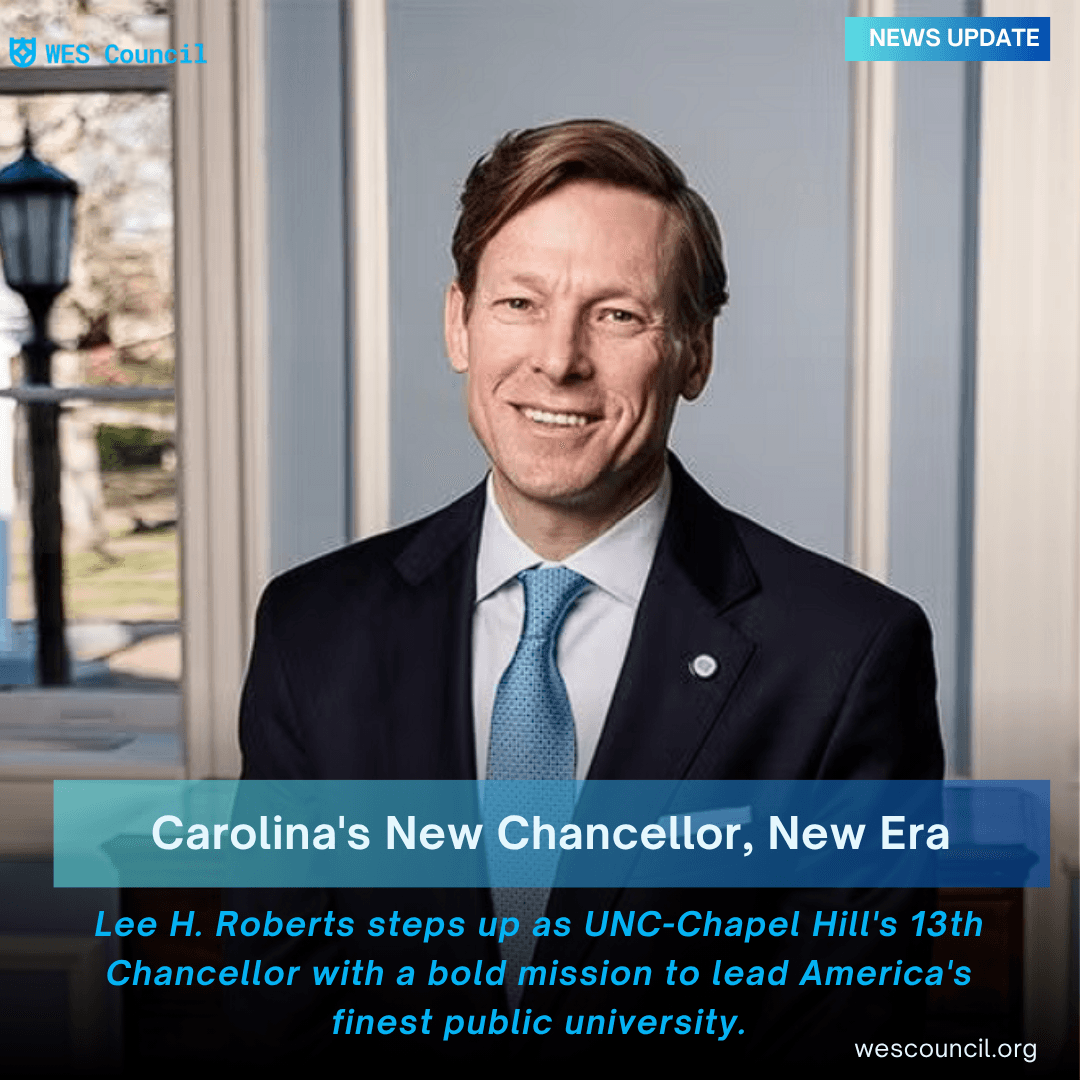

Lee H. Roberts Named 13th Chancellor of UNC-Chapel Hill: A New Chapter for the Nation's First Public University
The University of North Carolina at Chapel Hill has long stood as a symbol of academic excellence, civic purpose, and unwavering commitment to the people of North Carolina. It is a place where history breathes through every corridor and every graduating class adds a new verse to a story that stretches back 230 years. On August 9, 2024, that story gained a compelling new chapter — one shaped by the election of Lee H. Roberts as the university's 13th chancellor by the UNC Board of Governors. Roberts, who had already been steering the ship in an interim capacity since January of that year, stepped fully into the role with a sense of deep reverence for the institution's past and an equally energetic drive to define its future. His appointment was not simply a matter of administrative continuity — it marked the beginning of a carefully considered and boldly ambitious era for one of America's most storied public universities.
The World Education & Skilling Council (WES Council) recognizes leadership transitions like this as pivotal moments not just for institutions, but for the broader ecosystem of global education and skilling. When a leader of Chancellor Roberts' caliber takes the helm of a flagship public university, the decisions made in those early months reverberate across higher education, shaping how universities think about student success, workforce readiness, artificial intelligence, and the enduring value of a quality education.
From the Boardroom to the Chancellor's Office: Roberts' Journey
To understand why Lee H. Roberts was the right person to lead UNC-Chapel Hill into its next chapter, one has to look closely at the path he walked before arriving at this point. His journey to the chancellor's office was far from conventional. Unlike many academic leaders whose careers are rooted exclusively in faculty research or administrative higher education roles, Roberts brought with him a rare and valuable blend of private sector achievement, public policy expertise, and a deep personal commitment to the public good.
Roberts is the co-founder and managing partner of SharpVue Capital, a Raleigh-based private investment firm that specializes in stewarding institutional funds and supporting the growth of local economies across North Carolina. Building a successful investment firm requires strategic clarity, financial discipline, and the ability to make high-stakes decisions under pressure — all qualities that translate directly into institutional leadership. But Roberts did not stop at the private sector. He took his financial expertise into the public arena when he served as the State Budget Director for North Carolina from 2014 to 2016 under Republican Governor Pat McCrory. In that role, he helped design and shepherd through a landmark $2 billion Connect NC bond — a successful statewide referendum that funded campus construction and critical infrastructure improvements across North Carolina's public institutions.
Beyond those headline achievements, Roberts cultivated a breadth of civic engagement that reflected a genuine belief in the power of institutions to serve people. He served on the UNC Board of Governors, where he chaired the budget committee — giving him direct insight into the financial dynamics and strategic priorities of the UNC System. He also served on the State Board of Community Colleges, the State Banking Commission, the Golden LEAF Foundation Board, and the Board of Visitors at Duke University's Sanford School of Public Policy, where he also taught public budgeting classes as an adjunct professor. That teaching role was telling — it showed a man who wasn't content to simply make decisions from the top but was invested in passing knowledge on to the next generation of public servants.
His academic credentials are equally strong. Roberts earned a bachelor's degree in political science from Duke University before going on to study law at Georgetown University. These educational experiences — one grounded in understanding political systems and civic governance, the other in legal reasoning and institutional frameworks — equipped him with exactly the kind of analytical and humanistic perspective that a major public university demands of its leader. The University of North Carolina at Chapel Hill is not simply an academic machine; it is a civic institution, and Roberts understood that from the moment he walked through its doors.
A Search That Put Carolina First
The appointment of Lee H. Roberts did not happen in a vacuum, nor was it the result of a hurried decision. It followed a rigorous, transparent, and remarkably inclusive six-month national search that attracted nearly 60 qualified candidates from across the country. The process was designed from the outset to center the voices of those who knew Carolina best — its faculty, staff, students, alumni, and broader community of stakeholders. Seven forums were held on campus to gather perspectives, and surveys conducted throughout the process yielded an impressive 3,100 responses from people who cared deeply about the direction of their university.
A search advisory committee, chaired by Dr. Cristy Page — executive dean of the UNC School of Medicine, chief academic officer of UNC Health, and a faculty member — played a central role in identifying and evaluating candidates. Earlier in the week of the final decision, the UNC-Chapel Hill Board of Trustees had formally endorsed four finalists, all of whom had been vetted through the committee's thorough evaluation process. When the Board of Governors convened on August 9, 2024, their vote to elect Roberts reflected a consensus built through months of deliberation, listening, and thoughtful assessment.
Dr. Page, reflecting on the process, spoke to the strength of what emerged from those discussions. She noted that what stood out in conversations with candidates and within the committee itself was how robustly Carolina's national reputation for teaching and research had held up — even amid broader pressures facing higher education across the United States. The search, in many ways, became a reaffirmation of what UNC-Chapel Hill stands for: a commitment to academic rigor, a responsibility to serve the people of North Carolina, and an openness to leadership that can take the university from a position of strength to one of unquestioned national preeminence.
UNC System President Peter Hans, who formally recommended Roberts for the role, captured the mood of the moment when he described what he had observed during Roberts' months as interim chancellor. He praised Roberts for his calm, steady, and focused leadership — qualities that had brought a sense of reassurance and purposeful momentum to a university navigating a time of considerable change. Hans also spoke to the delicate balance Roberts struck: a deep and authentic respect for the university's long traditions and excellence, combined with a restless conviction that there was still so much more Carolina could become. That tension between honoring the past and demanding more of the future is, in many ways, the defining feature of the best institutional leadership — and it was precisely what set Roberts apart.
A Vision Built on Ambition and Excellence
From the very first days of his formal tenure as the 13th chancellor, Lee H. Roberts made it clear that he was not interested in incremental progress. He set his sights high — higher, perhaps, than any of his predecessors had done so explicitly. In one of his earliest public conversations as chancellor, speaking with The Well, the university's official news platform, he articulated a vision that was both bold and deeply grounded in Carolina's identity. "We should be committed to being, head and shoulders above, the best public university in the U.S.," he said. "In many ways, it's clear to me that we already are. But I think we should set as an ambition, an unambiguous view — in academia, in the broader public — that there's Carolina and then there's everybody else."
That kind of declaration — made not from arrogance but from a genuine belief in the university's potential — set the tone for everything that followed. Roberts acknowledged that reaching that standard would not happen overnight, but he argued that the goal itself was entirely worthy of an institution that has spent 230 years building a better future for North Carolina and its people. What made that ambition feel grounded rather than grandiose was the context in which he placed it: a fast-growing, vibrant state, strong enrollment demand, exceptional support from the state legislature and North Carolina's taxpayers, and a campus brimming with extraordinary students, faculty, and staff.
To translate that vision into action, Roberts moved quickly. He launched working groups to explore and develop future initiatives across four critical areas: enrollment growth, artificial intelligence, applied science, and capital planning. These were not vague aspirations — they were deliberate investments in the specific levers that would allow Carolina to grow in capability, in reach, and in impact. The artificial intelligence initiative was particularly forward-looking, reflecting an awareness that the universities which learn to harness AI thoughtfully and responsibly will be the ones that define the shape of higher education in the decades to come. Roberts also spoke with genuine enthusiasm about the new School of Civic Life and Leadership, which had gotten off to what he described as an "exceptionally fast and strong start." This new school reflected a belief that universities must remain in the business of preparing not just skilled professionals, but engaged and thoughtful citizens.
His goals extended beyond the classroom and the research lab. Roberts expressed his excitement about the university's opportunities in engineering, and he shared a compelling moment from his early months on campus when he toured the NC Pure Project labs — a research initiative developing technologies to efficiently remove PFAS (so-called "forever chemicals") from the Cape Fear River. Moments like that one illustrated his conviction that the university's research was doing real, consequential work in the world — work that most people didn't know enough about — and that telling those stories was part of the institution's responsibility to the public.
The Man Behind the Title: Legacy, Values, and Family
There is a dimension to Lee H. Roberts' story that adds a layer of meaning to his leadership that goes beyond professional accomplishment. He grew up in Bethesda, Maryland, the son of two prominent journalists — Steven Roberts and the late Cokie Roberts, who was one of the most respected political journalists in the history of American broadcasting. His grandparents served for decades in the United States Congress, representing Louisiana. That family lineage — steeped in journalism, public service, and civic responsibility — gave Roberts an early and deep understanding of why institutions matter, how public discourse shapes society, and why leaders must be accountable to the communities they serve.
That sense of accountability has defined his leadership style in tangible ways. Those who observed him during his months as interim chancellor noted his willingness to listen — genuinely listen — to faculty, staff, and students. He described himself as someone who was always working to be a better listener, more patient, and more focused. In an era when university leadership can sometimes feel distant or procedurally removed from campus life, that kind of self-awareness and humility is both rare and powerful. Roberts did not arrive at Carolina claiming to have all the answers. He arrived determined to ask the right questions, meet as many people as possible, and let the richness of the institution inform the decisions he would eventually need to make.
He and his wife, journalist and author Liza Roberts, live in Raleigh and have three children. That personal rootedness in North Carolina is not incidental to his role as chancellor of a public university — it is central to it. The University of North Carolina at Chapel Hill exists to serve the people of North Carolina, and having a chancellor who is genuinely part of that community, who has built his career in the state, raised his family here, and invested his professional life in its growth and well-being, matters enormously. It shapes how he sees the university's mission, how he prioritizes its resources, and how he relates to the students whose futures the institution is responsible for shaping.
He was formally installed as Carolina's 13th chancellor on October 11, 2024, during the university's 231st University Day celebration — a tradition that dates back to the founding of the nation's first public university and that marks, each year, both the anniversary of that founding and the enduring promise Carolina makes to the people of North Carolina. The ceremony was a fitting tribute to a man who had already demonstrated, in the months since his election, that he understood the weight of that promise and was ready to carry it forward.
What Lies Ahead: Carolina's Road to Unquestioned Preeminence
As Lee H. Roberts looks ahead, the challenges and opportunities facing UNC-Chapel Hill are significant — but so is its position of strength. The university is located in one of the fastest-growing and most economically dynamic regions in the United States. The Research Triangle area, home to UNC-Chapel Hill, Duke University, and NC State University, has become a magnet for technology companies, life sciences firms, and innovative startups, creating a symbiotic relationship between the university and the broader regional economy that Roberts is eager to deepen.
The working groups launched in Roberts' early months have already begun to bear fruit, and his administration's focus on artificial intelligence represents one of the most forward-looking bets any public university can make right now. The institutions that figure out how to embed AI into research, teaching, and administration — thoughtfully, ethically, and ambitiously — will be the ones that define higher education's trajectory for the next generation. Roberts has been vocal about UNC-Chapel Hill's intention to be among those leaders, not simply to follow trends set elsewhere.
At the same time, his administration has remained attentive to the bread-and-butter challenges that every public university must navigate: how to grow enrollment without sacrificing quality, how to manage capital and construction in a fiscally responsible way, how to support researchers and faculty in doing the work that makes Carolina's national reputation so strong, and how to ensure that every student who walks through Carolina's doors leaves better equipped to build a meaningful life and contribute to their community.
The World Education & Skilling Council (WES Council) sees in Chancellor Roberts' appointment and vision a reflection of the principles that drive global progress in education: a belief that institutions of learning must be held to the highest standards, that leadership must be both humble and ambitious, that education's ultimate measure is the impact it has on people and communities, and that the future belongs to those who invest now in building the knowledge and skills that the next generation will need. As UNC-Chapel Hill embarks on this new chapter under Roberts' leadership, it does so with a clear sense of purpose — and with a chancellor who has shown, in both word and action, that he is ready for the extraordinary work ahead.