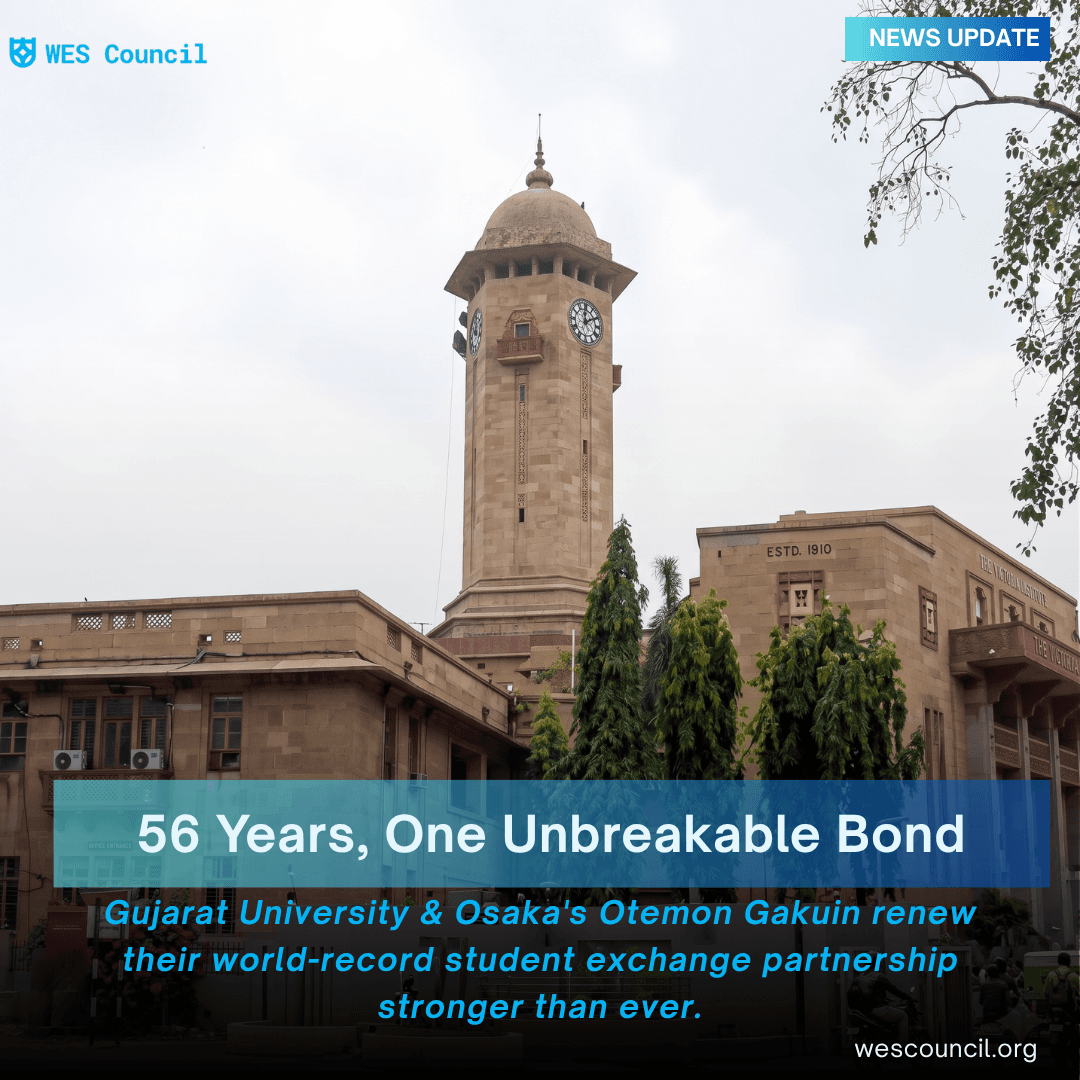

Gujarat University and Otemon Gakuin University Renew Their Historic 56-Year MoU, Reaffirming the Power of Global Academic Partnerships
In a moment that quietly but powerfully echoes across decades of shared learning and cross-cultural friendship, Gujarat University and Otemon Gakuin University of Osaka formally renewed their Memorandum of Understanding on April 22, 2026 . What makes this renewal truly stand out — even in a world that is increasingly connected through digital platforms and global exchange networks — is the extraordinary legacy behind it. This is not simply another institutional agreement being signed between two universities. It is the continuation of what is widely recognized as the world's longest-running student exchange program between any two universities, a partnership that has now stretched across an impressive 56 years . At a time when the World Education & Skilling Council (WES Council) consistently advocates for meaningful, sustained, and impact-driven global education partnerships, this milestone between Gujarat University and Otemon Gakuin University stands as a shining example of what long-term institutional commitment to international education truly looks like.
The story of this partnership is, at its core, a story about two nations — India and Japan — choosing to invest in each other's young minds long before international collaborations became routine in academia. The seeds of this relationship were planted more than five decades ago, during a period when establishing formal academic linkages across international borders required far more than digital documentation or virtual meetings. It demanded genuine vision, institutional trust, and a shared belief that education, when practised across cultural lines, produces minds that are not just knowledgeable but truly worldly. Gujarat University has nurtured and honoured that belief through every passing decade, and the renewal signed on April 22 is proof that this belief still holds firm today.
A Partnership That Outlasted Generations
To appreciate the full weight of what this MoU renewal represents, one has to consider the sheer span of time it covers. Fifty-six years in academia is not just a number — it is multiple generations of students, dozens of faculty cohorts, countless research collaborations, and thousands of hours of cross-cultural dialogue. The partnership between Gujarat University and Otemon Gakuin University began at a time when India's higher education system was still finding its footing on the world stage, and Japan was in the midst of its own rapid post-war transformation . That two universities from such different cultural and academic traditions chose to form a bond at that juncture, and then sustained it with genuine commitment through all the geopolitical, technological, and social shifts of the past five and a half decades, is a testament to something far more profound than academic policy — it is a testament to shared human values.
Otemon Gakuin University, situated in Osaka, Japan, is a private university that has long held a reputation for encouraging international dialogue and cross-border academic engagement. For Gujarat University, which is one of India's oldest and most distinguished public universities, this partnership has served as a vital window to one of Asia's most technologically and educationally advanced nations. Over the years, students from Ahmedabad have stepped off flights in Osaka carrying with them the intellectual curiosity of their home institution, just as Japanese students have arrived in Gujarat to discover an entirely different academic and cultural ecosystem. These exchanges have quietly been building bridges between two of Asia's most dynamic societies — and they continue to do so.
What the Renewed MoU Brings to the Table
The revised agreement signed in April 2026 is not simply a symbolic gesture or a routine administrative renewal. It comes loaded with practical intent and a clear vision for what the next chapter of this collaboration will look like. The renewed MoU specifically outlines a refreshed academic exchange programme for students, designed to align with the contemporary needs of global higher education . In an age where employers across industries increasingly value international exposure and cross-cultural competence, the importance of such structured exchange programmes cannot be overstated.
Beyond student exchanges, the renewed agreement also opens the door for faculty members from both universities to participate in academic exchanges, collaborative research, and joint learning initiatives . This is a particularly significant development because academic partnerships that remain limited to student exchanges often plateau after a certain point. When faculty members begin to collaborate — sharing methodologies, co-authoring research, conducting joint workshops, and developing shared curricula — the intellectual output multiplies manifold. The agreement between Gujarat University and Otemon Gakuin University appears to have recognized this, embedding faculty-level collaboration as a cornerstone of its renewed framework.
Furthermore, the MoU is expected to drive the exchange of academic materials that reflect the evolving educational landscapes of both India and Japan . This is a nuanced but important clause, because educational landscapes are not static. India's higher education sector has undergone enormous change in recent years — new national education policies, a growing emphasis on vocational training, the digitization of learning infrastructure, and a stronger focus on interdisciplinary studies. Japan, on the other hand, has been navigating its own transitions, from addressing demographic shifts that affect academic enrolment to integrating artificial intelligence and automation into its educational frameworks. When two universities commit to exchanging materials that reflect these evolving landscapes, they are committing to learning from each other in real time — not just exchanging old brochures and archived research papers.
The Broader Significance for India-Japan Educational Relations
The renewal of this MoU between Gujarat University and Otemon Gakuin University does not happen in isolation. It occurs against the backdrop of a steadily deepening bilateral relationship between India and Japan — one that has grown considerably stronger over the past decade across trade, technology, infrastructure, and of course, education. As governments and institutions on both sides continue to identify education as a strategic pillar of their partnership, this grassroots-level academic alliance serves as a powerful reminder that the most durable connections between nations are often forged not in ministerial chambers, but in university classrooms and student exchange dormitories.
For the students who will benefit from this renewed agreement, the implications are deeply practical. International academic exposure, particularly in Japan — a country that leads the world in technology, robotics, automotive engineering, cultural heritage, and service excellence — offers a perspective that simply cannot be replicated in any classroom setting alone . Students who spend time at Otemon Gakuin University return not just with academic credits but with a widened worldview, stronger language skills, refined research instincts, and a network of international peers that can define career trajectories for years to come. At WES Council, we have always maintained that the true value of education lies not just in what students learn, but in how that learning transforms them as global citizens — and partnerships like this one are exactly the mechanism through which that transformation happens.
Similarly, Japanese students who choose to spend a semester or a year at Gujarat University are stepping into one of India's most vibrant academic and cultural environments. Ahmedabad itself — Gujarat's largest city and a UNESCO World Heritage City — is a living classroom of history, entrepreneurship, textile craft, and urban innovation. The exposure that Otemon Gakuin students gain from immersing themselves in this environment enriches their understanding of South Asia, India's rapidly growing economy, and the diverse cultural mosaic that defines the Indian subcontinent. These are not learnings that any textbook, however well-written, can fully provide.
WES Council's Perspective on Long-Term Global Academic Alliances
At the World Education & Skilling Council, we believe that the future of education is fundamentally global. The challenges and opportunities that confront our world today — from climate change and digital transformation to economic inequality and rapid technological disruption — are not bound by national borders, and neither should the education systems that prepare young people to address them be. Institutions like Gujarat University and Otemon Gakuin University, which have demonstrated the patience and commitment to maintain a meaningful academic partnership across 56 years, deserve recognition not just as educational institutions but as pioneers of what internationalized education can and should look like.
The WES Council has consistently emphasized the role of structured international exchange programmes in building what we often call "globally ready" graduates — professionals who combine deep subject-matter expertise with the cross-cultural intelligence, adaptability, and collaborative instincts that today's world demands. The agreement between Gujarat University and Otemon Gakuin University is a perfect illustration of how such programmes work when they are embedded in a relationship of genuine institutional trust rather than transactional interest. Joint research projects, shared academic resources, and regular faculty collaboration — all of which are embedded in this renewed MoU — are precisely the kinds of mechanisms that translate institutional agreements into real student outcomes .
We also note that this partnership aligns closely with the National Education Policy's vision for internationalizing India's higher education landscape. As India moves to establish itself as a global education hub, bilateral partnerships like the one between Gujarat University and Otemon Gakuin University provide a roadmap for what sustainable academic diplomacy can look like. They demonstrate that it is possible to build academic relationships that outlast changes in government, shifts in university leadership, and fluctuations in bilateral political priorities — because they are grounded in something much more enduring than policy cycles: they are grounded in genuine mutual respect and intellectual solidarity.
Looking Ahead — The Next Chapter of This 56-Year Story
As the ink dries on the newly signed MoU, the academic communities at both Gujarat University and Otemon Gakuin University are no doubt already looking ahead to what this next chapter will hold. The emphasis on joint research projects, in particular, opens up exciting possibilities . India and Japan occupy complementary positions in many fields — India's strength in software development and data science pairs naturally with Japan's leadership in hardware engineering and robotics. In the humanities, India's rich philosophical and literary traditions offer fascinating counterpoints to Japan's own deeply cultivated cultural heritage. Collaborations in these and other domains can produce research that is both rigorous and genuinely cross-cultural in its methods and conclusions.
For faculty members who participate in the exchange component of this renewed agreement, the experience promises to be equally enriching. Teaching in a foreign academic environment requires educators to step outside their familiar frameworks, engage with students whose learning backgrounds differ significantly from their own, and find new ways to communicate ideas across linguistic and cultural boundaries. This process, while challenging, invariably makes educators more versatile, more empathetic, and more effective — qualities that ultimately benefit every student they teach thereafter.
The students who choose to participate in this exchange will be walking in the footsteps of generations who came before them — students who boarded flights between Ahmedabad and Osaka long before international travel became commonplace, who navigated language barriers with nothing but paper dictionaries and determination, and who returned home with friendships, insights, and experiences that shaped their professional and personal lives in ways they could not have anticipated. That legacy is now being passed on to a new generation, one that has the advantage of technology, broader global awareness, and a world more accustomed to cross-cultural interaction — but that still stands to gain just as much, if not more, from the deeply human experience of living and learning in another country.
Gujarat University's renewal of this MoU with Otemon Gakuin University is, in the truest sense, a gift to its students — a gift of perspective, possibility, and the rare opportunity to be part of a partnership that history has already validated. WES Council celebrates this milestone and looks forward to seeing the research collaborations, the student journeys, and the academic breakthroughs that the next phase of this extraordinary 56-year partnership will produce .