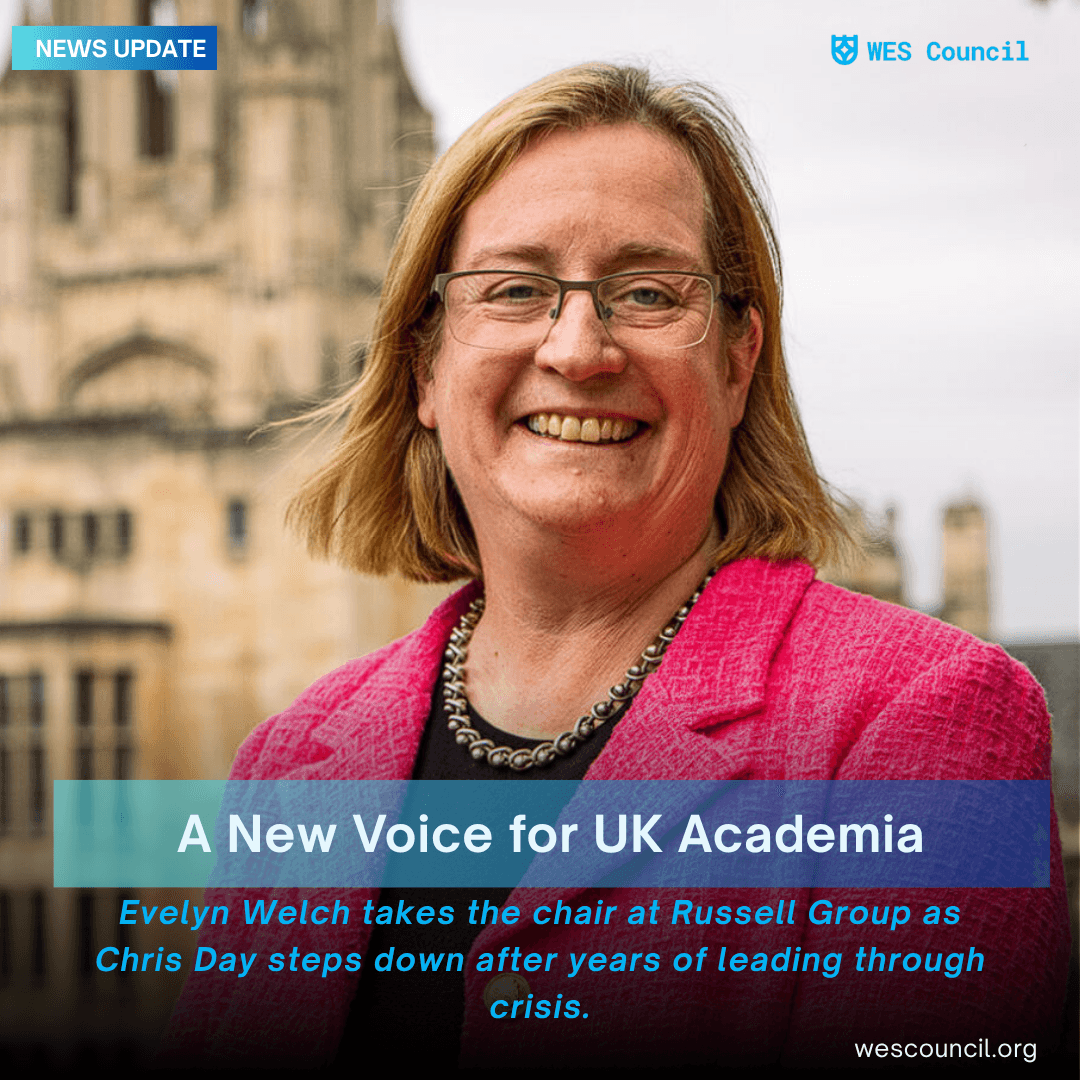

Evelyn Welch Set to Lead the Russell Group as Chris Day Concludes a Defining Chapter in UK Higher Education
The United Kingdom's higher education landscape has been no stranger to turbulence over the past several years — from pandemic disruptions and post-Brexit shifts in international student mobility to mounting financial pressure on institutions that were once considered untouchable pillars of academic excellence. Against this backdrop, the Russell Group, the body that represents 24 of the country's most research-intensive universities, has announced a significant leadership transition that many within the sector believe will shape the direction of UK academia for years to come.
Professor Evelyn Welch, Vice-Chancellor and President of the University of Bristol, has been officially named as the next Chair of the Russell Group. She will take up the position in August 2026, succeeding Professor Chris Day, who has steered the group through one of the most demanding periods in recent memory. Welch becomes the tenth individual to hold this role in the organization's history — a fact that carries symbolic weight given the scale of challenges she is stepping into.
For those working at the intersection of global education, skills development, and institutional leadership — including organizations like the WES Council (World Education & Skilling Council) — this appointment signals something broader than a simple change of guard. It marks a defining moment for the philosophy, direction, and ambitions of research-led higher education in the United Kingdom and, by extension, for international academic partnerships that institutions like the University of Bristol actively cultivate.
Understanding the Russell Group and Its Role in Shaping Global Education
Before examining what Welch's appointment means in practice, it is worth taking a moment to understand just how consequential the Russell Group is — not just for British students, but for the global academic ecosystem that organizations like WES Council engage with on a daily basis.
The Russell Group was formally established in 1994, initially as an informal gathering of vice-chancellors from leading UK universities who met at the Russell Hotel in London — hence the name. Over the decades, it evolved into a formal membership body representing 24 public research universities that collectively dominate the UK's research funding, doctoral training, and global academic rankings. Its membership includes some of the most recognized names in world academia: the University of Oxford, the University of Cambridge, University College London, the University of Manchester, King's College London, the University of Edinburgh, the University of Bristol, and many others.
Often described as the UK equivalent of the American Ivy League — or the Australian Group of Eight — the Russell Group holds an outsized influence on national education policy, government funding allocation, and international research collaboration. In a given academic year, Russell Group institutions receive the vast majority of competitively awarded research funding from UK Research and Innovation (UKRI), train the bulk of the country's doctoral candidates, and recruit a significant share of international students from across Asia, Africa, the Americas, and Europe. Their collective academic output shapes scientific discovery, informs public policy, and contributes enormously to the UK's GDP and global soft power.
For global education councils and bodies focused on skilling, standards, and cross-border academic recognition, the Russell Group's priorities matter greatly. Decisions made at this level ripple outward — affecting how universities develop curricula, how they partner with industry, and how they engage with international frameworks for qualifications and skills recognition. This is why leadership at the Russell Group is never purely ceremonial. The Chair sits at the heart of a complex web of institutional, governmental, and international relationships that determine how the UK positions itself in the global knowledge economy.
Who Is Professor Evelyn Welch — and Why Does Her Appointment Matter?
Evelyn Welch is not a newcomer to high-stakes academic leadership. She has served as Vice-Chancellor and President of the University of Bristol since September 2022, stepping into that role during a period when universities across the country were already beginning to feel the cumulative effects of frozen tuition fees, rising costs, and shifting geopolitical dynamics affecting international student enrolment.
Bristol itself is a prominent Russell Group institution — one with a long track record of world-class research, a strongly internationalized student body, and deep engagement with industry and civic communities. Under Welch's leadership, the university has continued to navigate those pressures while sustaining its academic mission and global reputation. Her experience managing a large, research-intensive university in this climate makes her, in many respects, an ideal candidate to take on the Chair role at a moment when the group needs someone who understands from the inside what member institutions are dealing with.
Welch, speaking about the appointment, was clear-eyed about both the honor and the responsibility it carries. "It is an honor to be named as the tenth Chair of the Russell Group," she said, adding that she welcomes "the opportunity to work with this outstanding group of world-leading universities, and with other higher education mission groups, as we continue to advocate for the importance of universities to the UK's success, nationally and globally."
What stands out in her framing is the collaborative tone — the explicit mention of working not just within the Russell Group, but across mission groups. This signals an awareness that the UK higher education sector cannot move forward through competition alone. Whether it is working with the broader university sector, industry partners, or international bodies invested in skilling and education standards, Welch appears to understand that coalition-building is now as important as advocacy.
She also connected the role to everyday impact in a way that goes beyond elite academic language. "Russell Group universities make a huge difference to people's lives every day," she noted, emphasizing that it is "a privilege to chair a body whose members support our NHS, our businesses and entrepreneurs, our cities and our regions." This grounding of research excellence in its real-world outcomes is a thread that resonates strongly with how organizations like WES Council frame the purpose of education — not as an end in itself, but as a mechanism for societal progress, economic empowerment, and human development.
Chris Day Steps Down: A Leadership Legacy Built Through Adversity
Every significant appointment is also, in some way, a recognition of the work that came before it. Chris Day's tenure as Chair of the Russell Group was defined by exactly the kind of volatility that would test any leader's mettle. He led the group through an extraordinary convergence of crises — a global pandemic that forced universities to transform overnight, a reshaping of the international student landscape, ongoing debates about freedom of speech on campuses, the fallout from Brexit on research collaboration and European Union funding, and more recently, the severe financial strain that has led multiple Russell Group institutions to announce redundancies and course closures.
Despite these challenges, Day maintained the Russell Group's coherence as an advocacy body and kept its voice visible in national policy conversations. His outgoing statement was warm and forward-looking. "It has been a privilege to Chair the Russell Group and to champion the vital role our universities play in improving lives, driving innovation and supporting economic growth," he said. He expressed confidence in his successor, adding that he looks forward "to seeing the group continue to deliver real-world impact for communities across the UK and beyond through our collective world-leading research and education."
It is worth acknowledging the specific challenges Day navigated, because they are precisely the challenges that Welch now inherits — and which the broader global education community, including the WES Council, will be watching closely. UK universities have been operating under a tuition fee cap that has not been meaningfully adjusted to account for inflation, meaning that in real terms, institutional income per student has declined year on year. This has created a structural funding gap that even well-endowed institutions have struggled to bridge. At the same time, government policy shifts have made international student recruitment more uncertain, which is a particularly acute concern for universities that depend significantly on overseas fee income to cross-subsidize research and domestic teaching.
Day's co-stewardship of the group through these years — alongside Deputy Chair Professor Shearer West and outgoing Chief Executive Tim Bradshaw — represents a period of institutional resilience under pressure, even if many within the sector would argue that more systemic reform was needed.
A New Executive Team: Libby Hackett Joins as Chief Executive
One of the most consequential developments accompanying Welch's appointment is the simultaneous change in the Russell Group's executive leadership. Tim Bradshaw, who served as Chief Executive, has stepped down. In the interim, Dr. Hollie Chandler is serving as Acting Chief Executive, and it is Chandler who has been publicly welcoming Welch in the transition period.
However, the appointment that will shape the organization's direction over the coming years is that of Libby Hackett, who is set to take up the permanent Chief Executive role in the near term. The fact that both the Chair and the Chief Executive will be new when the 2026–2027 academic year begins means that the Russell Group is, in effect, entering a fresh chapter with an entirely renewed leadership team. This is both an opportunity and a test.
Chandler's statement captured the optimism surrounding the transition well. "Across the UK, Russell Group universities are turning groundbreaking research into jobs and skills, creating opportunity and supporting communities to thrive," she said, welcoming Welch and emphasizing the group's role in connecting knowledge to economic and social impact. That framing — research to jobs to skills — is one that speaks directly to the agenda of education and skilling bodies worldwide. For the WES Council, which champions digital assessment innovation, skills recognition, and education leadership globally, the Russell Group's pivot toward a more explicit skills-and-outcomes narrative is a meaningful alignment.
The question many observers are already asking is whether Welch and Hackett together can achieve what has eluded their predecessors: a durable improvement in the policy and funding environment for research-intensive universities. The incoming team will need to make a compelling case to government not just for the symbolic value of world-class research, but for its direct return on public investment — something that is more urgent now than at any point in the Russell Group's history.
The Bigger Picture: UK Higher Education at a Crossroads
Welch's appointment cannot be fully understood without appreciating the scale of the structural challenges that the UK higher education sector currently faces. Across the country, universities — including several Russell Group members — have announced significant cost-cutting measures over the past two to three years. Courses have been discontinued, academic departments restructured, and in some cases large numbers of staff have been made redundant. These are not peripheral institutions struggling at the margins of the sector; they include flagship universities whose research reputations are internationally recognized.
The root causes are structural rather than situational. The freeze on domestic tuition fees — combined with rising operational costs driven by inflation and energy prices — has created a gap between income and expenditure that many universities have been unable to close. At the same time, a series of policy and messaging shifts around international student numbers have created uncertainty among the very cohort of students whose fees have historically helped to subsidize research activities and domestic student support. The result is a sector that is simultaneously expected to be world-class and chronically underfunded by the standards of comparable nations.
This is the landscape that Welch is walking into as Chair. And it is a landscape that has implications that stretch well beyond the UK. International partners, global education bodies, and organizations that work with UK institutions on research collaboration, student exchange, skills frameworks, and academic standards — including groups like the WES Council — have a stake in whether the UK can sustain the research and education capacity that makes these partnerships valuable. A weakened higher education sector in the UK would ripple outward, affecting the quality and scope of global academic collaboration for years to come.
Welch has been careful to signal that she understands this broader context. Her language has consistently linked the Russell Group's work to national outcomes — the NHS, business, entrepreneurship, regional development — while also positioning it within a global frame. This dual register, speaking simultaneously to domestic policy audiences and international partners, is exactly the kind of communication skill that the role demands.
For those engaged in education leadership conversations globally — whether at a conference hosted by the WES Council, through international accreditation dialogues, or within government-level education summits — the trajectory that Welch sets for the Russell Group over the coming years will be one to watch carefully. Her ability to build coalitions, make the case for sustained investment in research-intensive education, and navigate a genuinely difficult political environment will determine not just the fortunes of 24 universities, but in many ways the shape of the UK's contribution to global knowledge, innovation, and skills development for the decade ahead.