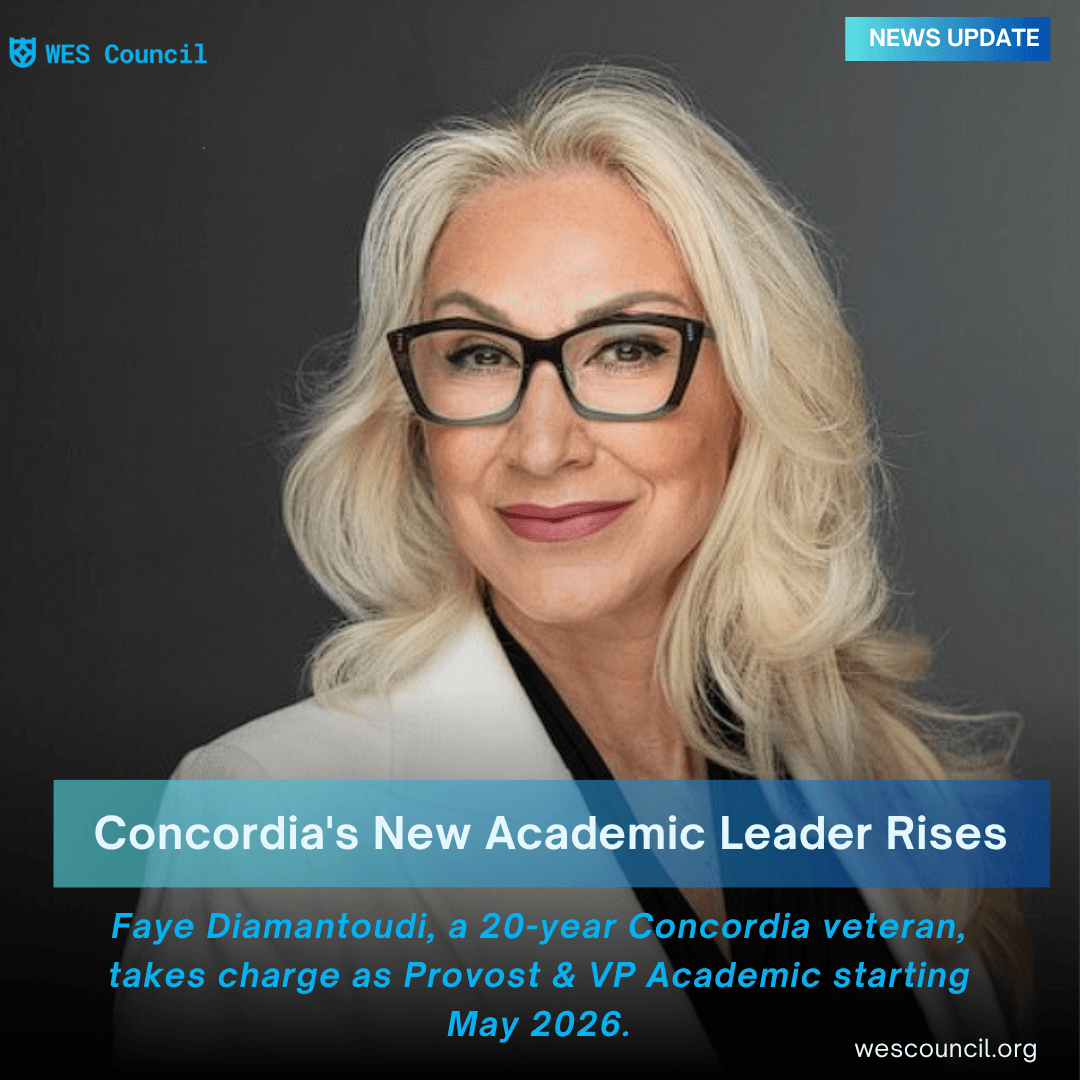

Concordia University Names Effrosyni Diamantoudi as Provost and Vice-President, Academic — A Landmark Moment for Canadian Higher Education
Concordia University has officially confirmed the appointment of Effrosyni "Faye" Diamantoudi as its new Provost and Vice-President, Academic, marking a defining chapter in the institution's evolving academic leadership story. Set to begin her five-year term on May 1, 2026, Diamantoudi steps into one of the most consequential roles in Canadian higher education — one that carries the weight of shaping academic vision, institutional strategy, and the overall direction of learning at a university that has long been celebrated for its commitment to innovation, inclusivity, and real-world impact. This appointment, approved by Concordia's Board of Governors, reflects not just institutional confidence in a seasoned academic, but a broader recognition that leadership rooted in depth, dedication, and decades of hands-on experience is what moves universities forward in an increasingly competitive global education landscape.
The decision carries particular resonance because Diamantoudi is not a newcomer parachuted into the role from outside. She is, at her core, a Concordia product — someone who has breathed the air of this institution for more than two decades, who has walked its corridors as a young assistant professor and grown alongside its students, faculties, and administrative culture. Her appointment, therefore, is as much a statement about institutional loyalty and internal talent development as it is about academic merit. For the World Education & Skilling Council (WES Council), which closely monitors leadership transitions across top global universities, this appointment stands as a compelling case study in how universities can build robust succession pipelines from within their own academic ecosystems.
A Trailblazer Rooted in Concordia's Academic Fabric
Effrosyni Diamantoudi's relationship with Concordia University is not one that began with her recent appointments to senior administrative roles. It goes back to 2003, when she first joined the university as an assistant professor in the Department of Economics — a department known for rigorous intellectual inquiry and strong engagement with both theoretical and applied economic thought. Over the years, she built a reputation as a thorough and passionate educator, one who not only contributed to the intellectual development of her students but also pushed the boundaries of academic research in her specialized domains. By 2015, her sustained scholarly contributions earned her the distinction of becoming a full professor, a milestone that reflects not just longevity but demonstrated excellence in teaching, research, and academic citizenship.
What makes Diamantoudi's story particularly compelling is the consistency with which she has grown within the same institution. In an era when academic talent often moves fluidly between universities, her two-decade-long commitment to Concordia represents a rare kind of institutional rootedness. She did not simply occupy a teaching role and wait for administrative opportunities — she actively shaped the university's academic culture, mentored graduate students, collaborated on research initiatives, and slowly but surely built the kind of institutional trust that leadership positions demand. For WES Council, this trajectory offers a powerful narrative about what long-term academic dedication looks like when paired with intellectual ambition and institutional investment in talent.
Her journey from assistant professor to full professor, and then through a series of increasingly significant administrative roles, did not happen by chance. It was the result of deliberate contribution, consistent excellence, and a genuine commitment to the broader mission of the university. When Concordia's leadership looked for someone to guide its academic affairs at the highest level, Diamantoudi's name carried the kind of institutional weight that can only be built over years of authentic service.
A Scholarly Legacy in Economics and Game Theory
Before understanding Diamantoudi as an administrator, it is essential to understand her as a scholar — because her academic work is not merely a footnote in her biography; it is the very foundation upon which her administrative credibility rests. Holding a PhD from McGill University, one of Canada's most prestigious institutions, Diamantoudi's academic specialization lies in the fields of Economic Theory and Game Theory. These are not areas defined by straightforward analysis — they require a kind of strategic, multi-layered thinking that examines how rational actors behave in complex systems, how coalitions form and dissolve, and how decisions made under uncertainty ripple through interconnected networks of interest.
Her research interests, particularly in Coalition Formation and Foresight, have real-world applications that extend far beyond the walls of academia. Understanding how groups cooperate, negotiate, and sustain collaborative relationships is deeply relevant to institutional management, policy-making, and even global education governance. It is perhaps not coincidental that someone whose academic life has been dedicated to studying strategic decision-making and coalition dynamics would emerge as an effective institutional leader — one capable of bringing together diverse stakeholders, navigating competing interests, and building durable alliances within a complex academic environment.
As a CIRANO (Centre Interuniversitaire de Recherche en Analyse des Organisations) Researcher and Fellow since 2016, Diamantoudi has also been part of a broader research network that bridges academic inquiry and policy application. CIRANO is known for its work at the intersection of social science research and real-world problem-solving, and her fellowship there speaks to her standing not just within Concordia but across the wider Canadian research ecosystem. For WES Council, which advocates for the alignment of academic leadership with research-driven decision-making, Diamantoudi's scholarly profile offers a textbook example of why research expertise and administrative leadership are not competing values — they are deeply complementary ones.
From Dean to Provost: A Journey of Institutional Leadership
Diamantoudi's path to the Provost's office was paved through a series of senior administrative appointments, each of which broadened her understanding of how a major research university functions and what it demands from its leaders. In February 2023, Concordia's Board of Governors approved her appointment as Dean of Graduate Studies for a five-year term — a role that placed her at the center of one of the university's most intellectually dynamic communities. As Dean, she was responsible for overseeing the academic development and well-being of thousands of graduate students, managing research integrity, and driving the kind of interdisciplinary collaboration that defines contemporary graduate education.
Her tenure as Dean was followed by an even broader institutional assignment when, in June 2024, she was named Concordia's Interim Vice-President of Research and Graduate Studies — a role that expanded her responsibilities to encompass the university's entire research enterprise. This was a significant moment in her administrative trajectory because it required her to think not just about students and programs, but about Concordia's positioning within the national and international research landscape. Managing research partnerships, funding strategies, and graduate program quality at that scale is an experience that few administrators accumulate, and it clearly prepared her for the demands of the Provost's office.
Then, in August 2025, when Anne Whitelaw stepped down as Provost and Vice-President, Academic after six years in the role, Diamantoudi was appointed as Interim Provost — essentially being trusted with the highest academic administrative seat in the university on an acting basis. This interim appointment was itself a clear signal of institutional confidence, a recognition that she was not merely capable of filling a gap, but that she was the person the institution wanted steering its academic direction during a period of transition. The fact that this interim role has now been converted into a full five-year appointment, beginning May 1, 2026, is the natural culmination of a leadership journey that has unfolded with remarkable consistency and purpose.
Anne Whitelaw, who served in the role from 2021 and had herself served in an earlier interim capacity before that, leaves behind a legacy of academic reform and institutional resilience. Diamantoudi's appointment as her successor is not just a change of guard — it is a continuation of a culture of thoughtful, dedicated academic leadership that Concordia has worked hard to cultivate over the years.
Championing Business Development and Academic Excellence Together
One of the more distinctive aspects of Diamantoudi's appointment is that it comes with an additional designation: Executive Lead on Business Development and Revenue Generation. This dual mandate places her in an unusual but increasingly necessary position — one that requires her to hold together the sometimes competing imperatives of academic integrity and institutional financial sustainability. In the current higher education environment, where universities around the world are navigating shrinking public funding, rising operational costs, and the growing demand for globally competitive research infrastructure, the ability to attract corporate partnerships, generate alternative revenue streams, and make the university attractive for strategic investment is no longer a peripheral function. It is a core institutional responsibility.
For Diamantoudi, this mandate is a natural extension of her scholarly background in economic theory and strategic decision-making. Her understanding of how actors behave within competitive systems, how value is created through coalition, and how long-term foresight shapes sustainable outcomes makes her uniquely equipped to lead Concordia's business development efforts without compromising the academic values that give those efforts their legitimacy and direction. The WES Council, which has long championed the idea that academic excellence and institutional sustainability are not in opposition but are in fact mutually reinforcing, sees this kind of integrated leadership as a model worth studying and replicating.
The challenge, of course, is to ensure that the pursuit of revenue and corporate investment does not come at the cost of academic freedom, equity of access, or the university's commitment to public service. Diamantoudi's deep roots within Concordia's academic culture suggest that she understands this balance acutely. Having spent over two decades as a faculty member before transitioning into administration, she carries with her an insider's perspective on what faculty and students need from institutional leadership — and why protecting the integrity of the academic mission is not just a moral obligation but a practical one.
What This Appointment Means for the Future of Higher Education
Effrosyni Diamantoudi's appointment as Provost and Vice-President, Academic at Concordia University is more than a personnel decision. It is a statement about what kind of leadership higher education institutions need at a moment when the sector is undergoing profound and accelerating transformation. Across the world, universities are being asked to do more — to produce research that matters, to prepare students for rapidly changing labor markets, to serve diverse and often underrepresented communities, and to do all of this with greater efficiency, transparency, and global ambition than ever before. The leaders who guide these institutions must therefore be more than accomplished scholars or experienced administrators. They must be strategic thinkers, coalition builders, and long-term visionaries who can hold the complexity of modern university life with both competence and grace.
Diamantoudi brings all of these qualities to the role. Her academic background in game theory and coalition formation is not merely an intellectual credential — it is a lived philosophy about how change happens in complex systems, and how leadership in those systems requires patience, strategic foresight, and a genuine understanding of the interests and motivations of every stakeholder. Her administrative journey through graduate studies, research leadership, and the Provost's office has given her a 360-degree view of university operations that few leaders at her level can claim.
For WES Council, an organization deeply invested in the quality and direction of global education and skilling ecosystems, appointments like these serve as important data points in understanding where higher education is headed. When a university of Concordia's stature chooses a leader who combines scholarly depth, institutional loyalty, economic expertise, and a commitment to both academic excellence and financial sustainability, it signals a maturation in how the sector thinks about what leadership should look like. It moves beyond the outdated binary of "academic versus administrator" and recognizes that the best leaders are those who have never truly left either world behind.
As Diamantoudi begins her five-year term on May 1, 2026, Concordia University enters a new phase — one shaped by continuity of values, fresh institutional energy, and the kind of leadership that comes from knowing an institution deeply and choosing, year after year, to invest in its future. The higher education world will be watching, and for those who believe that great universities are built by great people who stay and grow, this appointment offers something genuinely hopeful to reflect on.