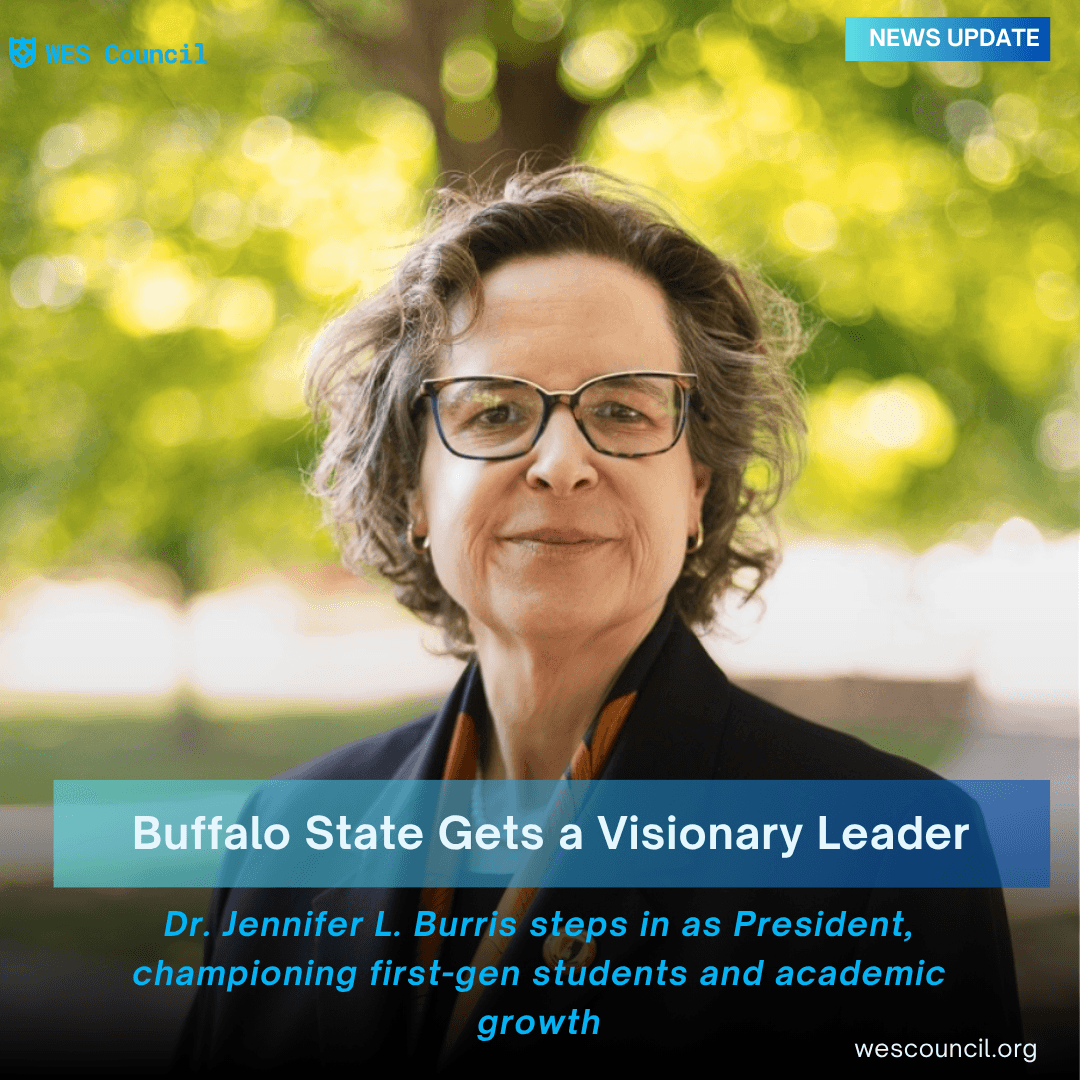

Jennifer L. Burris, Ph.D., Named as the 11th President of Buffalo State University — A New Chapter Begins
Buffalo State University has reached a defining milestone in its storied academic journey. On April 28, 2026, the State University of New York (SUNY) Board of Trustees formally voted to appoint Jennifer L. Burris, Ph.D., as the next president of Buffalo State University — a decision that has been received with widespread enthusiasm from university stakeholders, civic leaders, and the broader Western New York community. Her appointment takes effect on July 1, 2026, marking a transformational moment not only for the institution but also for the students and communities it serves. At WES Council, we believe that appointments like these reflect a growing global understanding that strong, values-driven academic leadership is among the most powerful catalysts for educational transformation.
Dr. Burris steps into this role at a time when higher education institutions across the United States are navigating complex challenges — from shifting enrollment trends and financial pressures to evolving student needs and the growing demand for institutions that prioritize access and social mobility. Her appointment signals that Buffalo State University is not merely responding to these challenges; it is actively preparing to lead through them. As an organization deeply committed to advancing education and skilling frameworks worldwide, WES Council recognizes the significance of this leadership transition and what it could mean for the future of student-centered, mission-driven higher education.
A Leader Rooted in Academic Excellence and Student Success
Before being named as the incoming president of Buffalo State University, Dr. Jennifer L. Burris built a distinguished and diverse career in higher education — one shaped by deep academic grounding, administrative leadership, and an unwavering commitment to student success. She currently serves as Provost and Vice President for Academic Affairs at Lenoir-Rhyne University, located in Hickory, North Carolina. In this role, she has overseen academic innovation and student success initiatives across six colleges, the Lutheran Theological Southern Seminary, and a wide range of student support and academic service divisions. Her work at Lenoir-Rhyne has earned her a reputation as a collaborative, forward-thinking leader who bridges the worlds of faculty governance and institutional strategy with remarkable effectiveness.
What makes Dr. Burris particularly compelling as a leader is the scientific rigor that underlies her worldview. She is a physicist by training, holding a Ph.D. and M.S. in Physics from Colorado State University, and a Bachelor of Science in Applied Science with a Physics concentration from the University of North Carolina at Chapel Hill. This grounding in empirical thinking and quantitative analysis has informed the way she approaches institutional challenges — with data, precision, and a commitment to outcomes that are measurable and meaningful. It is rare to find a university president who brings both the warmth of a devoted educator and the analytical sharpness of a research scientist, and Dr. Burris appears to embody both qualities with grace and confidence.
Prior to her time at Lenoir-Rhyne, Dr. Burris held multiple leadership roles at Appalachian State University. She served as an associate dean, department chair, and chair of the Council of Chairs — a progression that gave her hands-on experience managing complex academic units and navigating faculty relationships at every level of institutional governance. She also served as a principal investigator on multiple competitive grants, most notably a $1 million NSF:ADVANCE award that focused specifically on the recruitment and retention of diverse faculty and staff. This kind of grant leadership demonstrates not just administrative competence, but a genuine dedication to building academic communities that reflect the full diversity of human experience and potential.
Buffalo State University: SUNY's Urban-Engaged Anchor Institution
To fully appreciate why this appointment carries such significance, it is essential to understand what Buffalo State University represents — not just in the context of the SUNY system, but within the larger landscape of American public higher education. Buffalo State University has long served as what Dr. Burris herself described as "SUNY's urban-engaged anchor institution" — a place that creates life-changing opportunities for first-generation college students, transfer students, and learners from communities that have historically been underserved by the higher education system.
The university, situated on Elmwood Avenue in Buffalo, New York, occupies a unique and vital position in Western New York. It is deeply embedded in the social, economic, and cultural fabric of the city, and its success is widely understood to be inseparable from the city's broader aspirations. When institutions like Buffalo State thrive, entire communities feel the ripple effects — in employment, in civic engagement, in intergenerational mobility, and in the cultivation of a workforce equipped for the demands of the modern economy. This is precisely the kind of educational mission that WES Council champions in its work to advance global education and skilling standards.
What distinguishes Buffalo State from many of its peer institutions is its deliberate commitment to access. The university has prioritized pathways for students who might otherwise fall through the cracks of more selective institutions — students who are often the first in their families to attend college, who juggle jobs and caregiving responsibilities alongside their studies, and who need not just academic instruction but holistic support systems to succeed. Dr. Burris's track record of building exactly those kinds of support systems is one of the primary reasons she emerged as the ideal candidate for this presidency.
Voices of Confidence: What Leaders Are Saying
The announcement of Dr. Burris's appointment drew an outpouring of support from across the educational and civic spectrum, reflecting the broad coalition of trust and optimism that now surrounds her incoming leadership. SUNY Chancellor John B. King Jr. was among the first to offer his congratulations and his confidence in her ability to guide Buffalo State into a strong future. "I am confident her extensive experience as a faculty member, administrator, and researcher will help the campus continue on a path to a strong future," Chancellor King said, underscoring the depth of institutional backing behind this decision.
Linda Dobmeier, who served as chair of both the Buffalo State Council and the Presidential Search Committee, offered perhaps the most personal and illuminating assessment of what makes Dr. Burris stand apart from the field. She noted that beyond Dr. Burris's impressive professional record, it was her "genuine warmth, her commitment to first-generation students, and her understanding of our university's vital role in supporting and strengthening our local community" that truly distinguished her. Dobmeier also highlighted a critical achievement: Dr. Burris has a demonstrated track record of closing structural deficits through data-informed planning while simultaneously driving gains in enrollment and retention — a combination of fiscal discipline and human-centered strategy that is increasingly rare in academic leadership.
Buffalo Mayor Sean Ryan added a powerful civic dimension to the conversation, emphasizing that Buffalo State's health is directly tied to the city's future. "Her track record of strengthening academic institutions and restoring fiscal stability speaks for itself," Mayor Ryan said, signaling that the city's government sees Dr. Burris not just as a university president, but as a partner in Buffalo's broader urban renewal story. State Assembly Majority Leader Crystal Peoples-Stokes, herself a Buffalo State alumna, expressed personal excitement about the appointment and praised Dr. Burris as "someone who builds community both within and outside of the university" — a quality that is essential for an institution whose impact extends far beyond its campus boundaries.
A Philosophy Built on Transparency, Shared Governance, and Human Potential
At the heart of Jennifer Burris's leadership philosophy lies a set of principles that feel particularly resonant in today's educational climate. She has spoken openly about her commitment to shared governance — the idea that meaningful institutional decisions should emerge from inclusive dialogue among faculty, staff, students, and administrators, rather than from a top-down hierarchy that sidelines the very people closest to the educational mission. This approach requires a certain kind of intellectual humility and emotional intelligence, and it is exactly the kind of leadership posture that earns long-term trust within complex academic communities.
Dr. Burris has also been explicit about her belief in transparency as a foundational leadership value. In an era when many institutions have faced criticism for opaque decision-making and communication gaps between administration and the campus community, her commitment to openness is not merely a philosophical preference — it is a practical strategy for building the kind of institutional culture where innovation can flourish and where people feel safe to take risks, share ideas, and contribute to collective problem-solving. This aligns closely with WES Council's own conviction that educational institutions thrive when they operate as genuine communities of learning and growth, rather than bureaucratic structures managing processes from a distance.
Perhaps most powerfully, Dr. Burris's philosophy centers on the belief that every individual — regardless of their background, their starting point, or the obstacles they have faced — deserves access to the support systems and opportunities that make transformation possible. Her focus on non-academic spaces as sites of student success is particularly noteworthy. She recognizes that students do not only struggle or succeed in classrooms; they need advisors who know their names, campus cultures that feel welcoming, mental health resources that are accessible, and financial guidance that helps them navigate the often-confusing terrain of higher education. Her vision for Buffalo State appears to embrace all of these dimensions of student well-being.
What This Appointment Means for the Future of Higher Education
Looking ahead, Dr. Jennifer L. Burris's appointment to the presidency of Buffalo State University raises important and exciting questions about the direction of public higher education in the United States. Her selection signals a growing institutional appetite for leaders who combine academic credibility with strategic acumen, data-driven decision-making with genuine compassion, and a commitment to fiscal responsibility with an equally strong commitment to mission-driven investment in student success. These are qualities that WES Council believes should define educational leadership at every level, across every system.
Her appointment also carries important implications for conversations about diversity and representation in academic leadership. As a woman leading a major public research and teaching university, Dr. Burris joins a cohort of leaders who are reshaping what academic authority looks and sounds like — not by abandoning the intellectual rigor and strategic thinking that the role demands, but by bringing to it a broader range of experiences, values, and relational approaches. This matters because universities do not just educate students through curriculum; they educate them through the examples they set and the communities they build.
For Buffalo State University specifically, the arrival of Dr. Burris on July 1, 2026, represents an opportunity to build on the strong foundation laid by outgoing President Bonita Durand, whose dedicated stewardship has been widely acknowledged and praised. Dr. Burris has herself expressed deep gratitude for President Durand's contributions and has framed her own incoming leadership in the spirit of continuation and growth rather than disruption. This kind of gracious and collaborative transition is itself a model of institutional health — and a strong signal that Buffalo State is entering this next chapter from a position of strength, purpose, and shared ambition.
At WES Council, we extend our warmest congratulations to Dr. Jennifer L. Burris on this remarkable appointment. We look forward to watching her leadership unfold and to the continued excellence of Buffalo State University as it serves its students, its city, and its community with distinction.